For most forms of lens surgery, an important decision is made before the operation begins: what optical power should the artificial lens have? Detailed measurements and sophisticated calculations allow surgeons to plan that power with considerable precision. But every eye heals individually, which means the final prescription after surgery cannot always be predicted perfectly in advance.
The Light Adjustable Lens (LAL) introduces a fundamentally different idea.
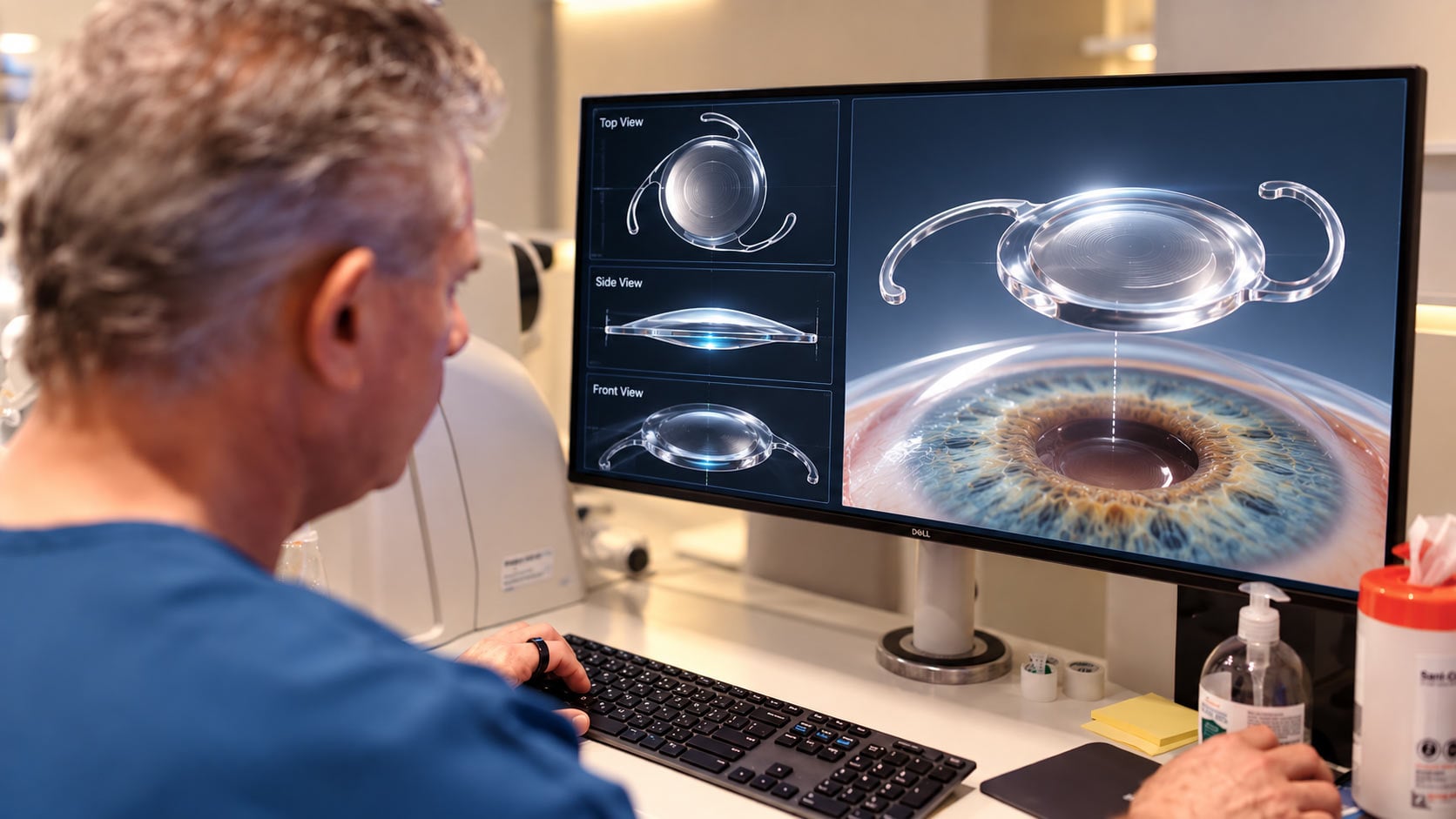
Instead of permanently fixing the final optical result at the moment the lens is implanted, the LAL is made from a special photosensitive material that allows its focusing power to be refined after surgery. So yes, an artificial lens inside the eye really can be adjusted without replacing it. But how can light change a lens that has already been implanted, and why might being able to experience your vision before finalising it be useful?
Most Artificial Lenses Are Planned Before You Can See Through Them
During lens replacement or cataract surgery, the natural crystalline lens is removed and replaced by an intraocular lens, usually shortened to IOL. With a conventional fixed-power IOL, detailed measurements taken before surgery are used to calculate the lens power expected to produce the intended visual result. Once implanted, that optical power is fixed.
The Light Adjustable Lens changes the sequence.
When Is Your Vision Finalised?
Measure → Calculate → Implant
Implant → Heal → Refine
How Can Light Change an Artificial Lens?
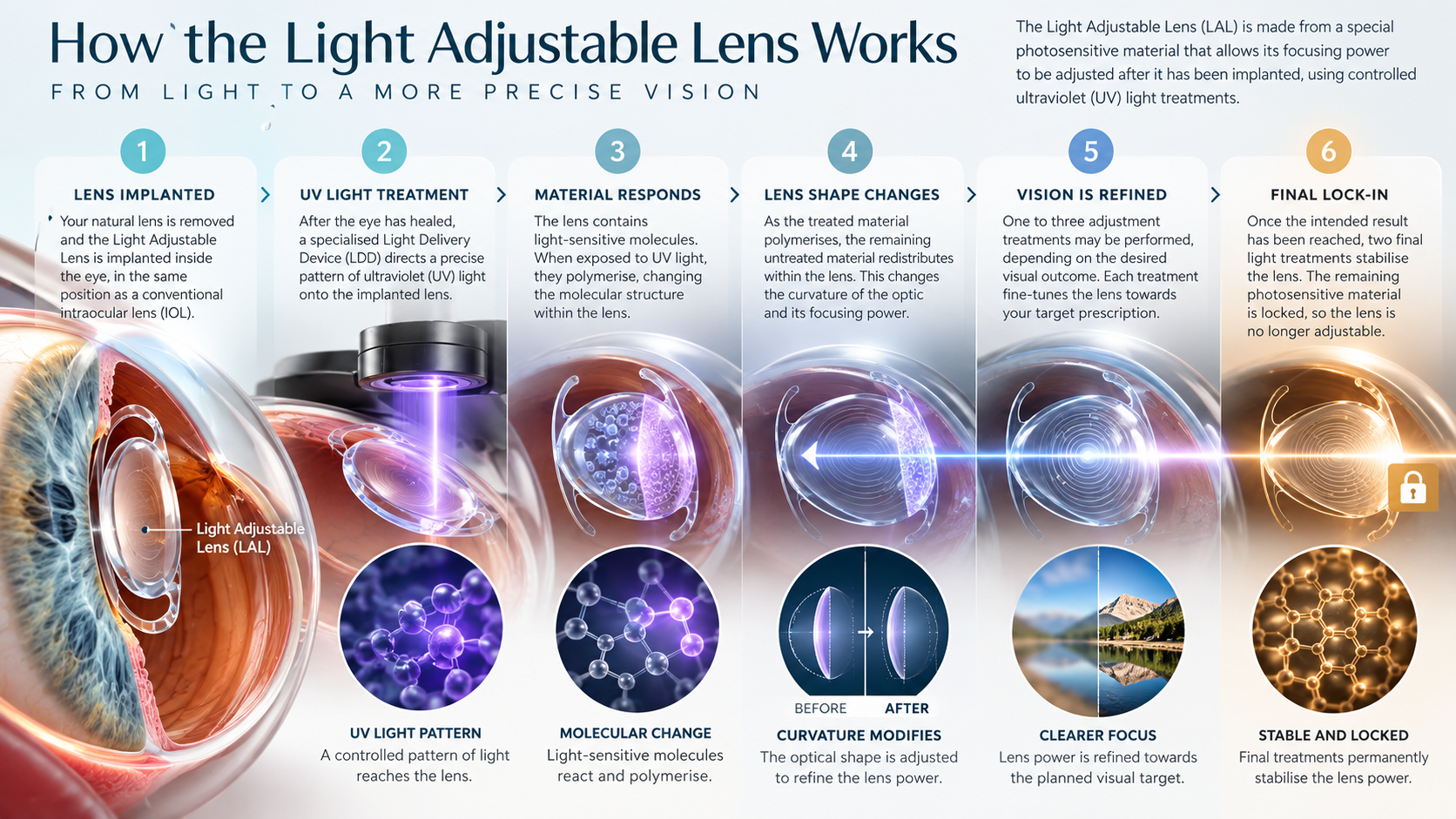
The clever part lies within the material used to manufacture the lens. The Light Adjustable Lens contains light-sensitive molecules. After the eye has healed sufficiently, a specialised Light Delivery Device (LDD) directs a controlled pattern of ultraviolet light onto the implanted lens. The light triggers a molecular process within the lens material. Light-sensitive components exposed to the treatment polymerise, while remaining unpolymerised material redistributes within the lens.
That redistribution changes the curvature of the optic and therefore alters its refractive power.
From Light to a New Lens Power
A simplified look at what happens inside the Light Adjustable Lens.
UV Light
A precise treatment pattern reaches the lens.
Material Responds
Photosensitive molecules react to the light.
Shape Changes
The optical curvature is modified.
Focus Changes
Lens power is refined towards the planned target.
No additional operation is required to make those adjustments. The treatments take place in the clinic using the Light Delivery Device.
Why Adjust Vision After Surgery?
Modern lens calculations are highly sophisticated, but surgery involves living tissue.Measurements taken before an operation allow the surgeon to predict the IOL power required. The final refractive result can also be influenced by how the eye heals, the effective position of the implanted lens, corneal characteristics and other individual factors. With a conventional fixed IOL, the lens itself cannot subsequently be fine-tuned.
The LAL creates an opportunity to measure the eye after it has undergone surgery and begun healing, then use that information when refining the implanted lens.
Instead of relying entirely on predicting your final prescription before surgery, the LAL allows refinement after your eye has started showing us its actual postoperative result.
You Can Experience Your Vision Before It Is Locked In
Another unusual feature of the Light Adjustable Lens is the opportunity to discuss vision after experiencing the implanted lens in everyday life. Before final lock-in, your London Vision Clinic surgeon can assess your postoperative prescription and discuss how your vision is working for activities that matter to you. Someone who spends much of the day using screens may have different priorities from someone who reads extensively or drives frequently.
For selected patients, the two eyes may also be planned to work together with slightly different focal targets, creating a blended range of vision. The aim is not unlimited adjustment or the ability to switch between completely different lens technologies. Rather, the implanted LAL provides a defined range within which its refractive power can be refined before the result is permanently locked.
What Does the Light Adjustable Lens Journey Look Like?
The LAL requires more involvement after surgery than a conventional fixed lens. Adjustment is a process rather than a single postoperative appointment.
Implant. Experience. Adjust. Lock.
Lens Surgery
Your natural lens is removed and the Light Adjustable Lens is implanted inside the eye.
Healing
The eye is allowed to recover and stabilise sufficiently before adjustment begins. The clinical team determines when the eye is ready.
Experience Your New Vision
Your postoperative vision and prescription can now be assessed rather than relying solely on the prediction made before surgery.
Light Adjustment
Controlled UV light is delivered to the lens to refine its optical power towards the agreed visual target.
Refine If Required
Depending on the visual target and measured result, further adjustment treatments can be performed before finalisation.
Lock In
Once the intended visual result has been reached, final light treatments stabilise the lens power permanently.
How Many Light Treatments Are Needed?
The exact schedule is determined individually.
According to RxSight’s current UK patient information, patients may receive one to three adjustment treatments, depending on the desired visual outcome, followed by two lock-in treatments. The first adjustment is generally considered after the eye has healed sufficiently, often from around three weeks after surgery, although the treating ophthalmologist determines when an individual eye is ready.
Why Do You Need Special UV-Protective Glasses?
The feature that makes the lens adjustable also means it needs protection until the adjustment process has been completed. Before final lock-in, the lens remains sensitive to ultraviolet light. Patients are therefore provided with specialist UV-protective glasses and must follow the clinical team’s instructions about when and how they should be worn.
Before Lock-In
The implanted lens remains responsive to UV light.
UV Protection
Protective eyewear is used according to the postoperative instructions.
After Final Lock-In
The remaining photosensitive material has been stabilised.
What Can Actually Be Adjusted?
The adjustment process can refine the refractive power of the implanted lens, allowing the surgeon to address residual focusing error within the treatment range of the technology. That can include spherical refractive error and astigmatism. The ability to refine the postoperative prescription may be particularly interesting where achieving a precise refractive target is more challenging.
What About Eyes That Have Previously Had LASIK?
Previous laser vision correction is an especially interesting example.
LASIK, LASEK, PRK and related procedures alter corneal shape. Years later, those changes can make calculating the ideal power of an intraocular lens more complex because conventional formulae have to account for a cornea that has already been surgically modified. Post-refractive lens calculations have improved enormously, but the LAL offers another advantage: the final refractive result can be refined after the eye has healed.
A 2024 study of 76 eyes with previous corneal refractive surgery treated with the second-generation LAL reported that 74% achieved uncorrected distance vision of 20/20 or better, while 88% achieved 20/25 or better. The study was retrospective, so its results should not be interpreted as a guarantee for an individual patient.
The Cornea Has Changed. The Lens Calculation Must Account for It.
Post-LASIK and post-PRK eyes require careful diagnostic assessment regardless of the IOL selected. Adjustability provides an additional way of refining the refractive result after implantation; it does not replace accurate measurement, surgical planning or appropriate patient selection.
Does Adjustable Mean You Can Keep Changing Your Eyesight Forever?
No.
The LAL has a defined adjustment period following surgery. Once the desired refractive target has been reached, the lens undergoes final lock-in treatments. After that process, the lens is no longer intended to remain adjustable. It is therefore better to think of the technology as postoperative customisation rather than a permanently programmable lens.
Is the Light Adjustable Lens a Trifocal Lens?
No. They are different approaches to managing vision after lens surgery.
Trifocal lenses use an optical design intended to provide focal points for near, intermediate and distance vision. EDOF lenses use optics designed to extend the range of focus. The Light Adjustable Lens is distinguished by something different: its refractive power can be modified after implantation and healing.
Depending on the patient’s visual priorities, LAL treatment can also be planned using different targets between the two eyes to extend functional vision. Suitability and the intended visual strategy need to be discussed individually.
What Does the Research Tell Us?
Light Adjustable Lens technology has been studied for many years, including its ability to correct residual refractive error after lens implantation and its use in eyes that have undergone previous corneal laser surgery. More recently, a 2026 multicentre prospective registry reported outcomes from 1,101 patients and 2,202 eyes implanted bilaterally with the LAL. The study included both previously untreated corneas and eyes with previous corneal refractive surgery, and reported a high degree of refractive precision across both groups.
Large studies are valuable, but published averages cannot predict the outcome for an individual eye. Eye health, previous treatment, visual goals and suitability remain central to clinical decision-making. Readers interested in the evidence behind advanced refractive surgery can explore London Vision Clinic’s scientific publications in advanced laser and lens surgery.
Is More Adjustability Automatically Better?
Not for every patient.
The Light Adjustable Lens has an obvious technological appeal, but lens selection should never become a contest over which implant has the most advanced-sounding feature. Some people may prefer the visual characteristics offered by a trifocal or EDOF design. Others may value a monofocal strategy. Eye health can also make particular technologies more or less appropriate.
LAL treatment additionally requires commitment to the postoperative adjustment programme and UV-protection instructions before final lock-in.
The Most Advanced Lens Is Not Necessarily the Most Appropriate Lens for Every Eye.
Eye health
Previous surgery
Reading
Screen use
Night driving
Visual priorities
From Predicting Vision to Refining It
The Light Adjustable Lens represents an interesting change in the philosophy of lens surgery. Traditional IOL planning asks surgeons to use measurements and calculations to predict the lens power that will produce the desired result.
Accurate prediction remains essential with the LAL, but the process adds another stage.
The patient can experience their postoperative vision, the eye can be measured after healing has begun, and the implanted lens can then be refined before its optical power is permanently locked.
For suitable patients, particularly those who value refractive precision or whose eyes present additional calculation challenges, that ability can be compelling. But the technology does not remove the need for careful diagnostics, realistic expectations or expert treatment planning.
The future of lens surgery may therefore be about more than choosing an artificial lens before an operation.
It may increasingly be about experiencing your new vision before deciding exactly where you want it to finish.