When a Headache Makes You Question Your Eyesight
There is something particularly frustrating about a headache when you cannot work out where it is coming from. Perhaps it begins after a few hours at your computer, develops during an evening drive or arrives with a familiar sensitivity to light. You might blame your eyesight, your glasses, a poor night’s sleep or simply another demanding day. But if you have recently undergone laser eye surgery, or are considering it, another question may naturally arise: could the procedure have something to do with it?
It is a reasonable question, and one that deserves a more thoughtful answer than a simple yes or no. Headaches have many possible causes, while migraines are a neurological condition with their own characteristic symptoms and triggers. Laser eye surgery changes how the eye focuses light, but it does not directly treat the neurological processes responsible for migraine. Understanding where these different systems meet is the key to separating coincidence, temporary visual discomfort and symptoms that require further investigation.
Can Laser Eye Surgery Actually Cause Headaches?
Headache is not usually considered one of the defining complications of laser eye surgery. The more familiar effects during recovery involve the eyes themselves, including temporary dryness, irritation, fluctuating vision and sensitivity to bright light. Nevertheless, some of these changes may coincide with headaches or contribute to discomfort in people who are particularly sensitive to visual disturbances.
Imagine looking through a window that is perfectly clear one moment and slightly misted the next. You can still recognise everything outside, but the inconsistency becomes distracting. During the early stages of healing, some patients experience a similar fluctuation in visual clarity. It does not mean that the eyes are being damaged by ordinary visual tasks, but the experience may feel tiring, particularly when combined with prolonged screen use or an existing tendency towards headaches.
The important point is that a possible connection is not the same as a proven cause. A headache that develops after surgery may relate to visual symptoms, medication, stress, dehydration, a pre-existing migraine disorder or something entirely unrelated. An appropriate assessment considers the whole picture rather than assuming that the most recent event must be responsible.
Why Might Your Eyes Feel Different During Recovery?
Most people spend remarkably little time thinking about the mechanics of sight. We open our eyes, focus on what matters and expect the world to appear reasonably consistent. When that familiar experience changes, even temporarily, we become much more aware of every flicker, reflection and moment of blur.
Following LASIK, SMILE or surface laser procedures such as PRK, the cornea undergoes a healing process. The nature and duration of recovery vary according to the treatment, the individual eye and the patient’s circumstances. During this period, changes in tear-film stability, visual clarity or light sensitivity can make familiar activities feel less comfortable than usual.
These experiences are not unique to laser eye surgery, and none establishes a diagnosis of migraine. They simply help explain why the relationship between vision and physical comfort can be more complicated than it first appears.
Headaches and Migraines Are Not the Same Thing
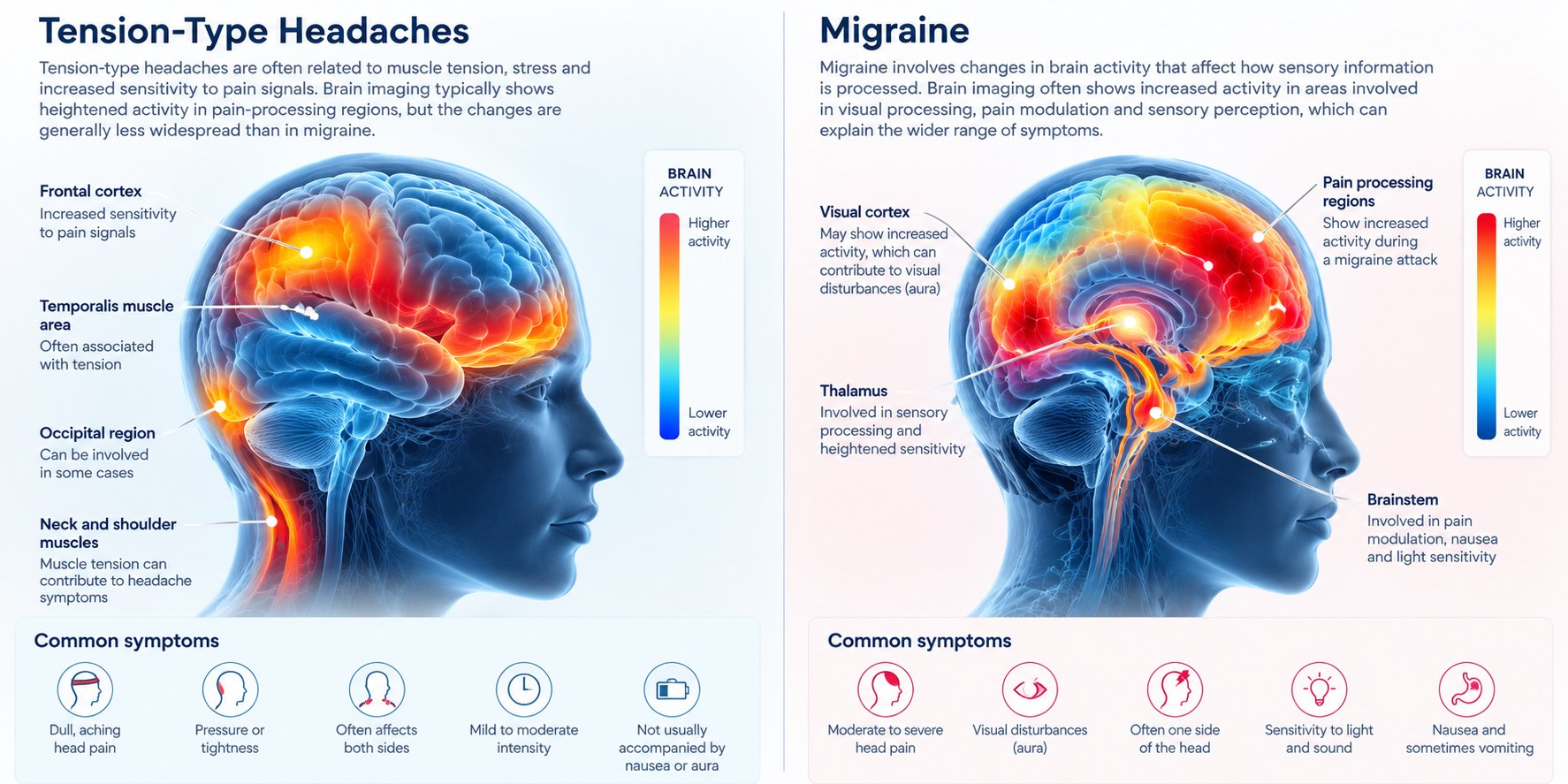
We often use the word migraine casually to describe a particularly unpleasant headache. Clinically, however, migraine is a neurological disorder, and the distinction matters. A migraine attack may involve moderate or severe head pain, nausea, sensitivity to light or sound, and sometimes neurological symptoms known as aura. Not every migraine includes a headache, and not every severe headache is a migraine.
A tension-type headache, by comparison, is often experienced as pressure or tightness around the head. Other headaches may be associated with illness, medication use, neck problems or numerous additional causes. Symptoms that appear to be related to the eyes can sometimes originate elsewhere, which is why persistent or recurring headaches deserve proper assessment.
Can Changes in Vision Trigger a Migraine?
For some people living with migraine, bright light, visual discomfort or changes in routine are associated with attacks. Yet identifying a genuine trigger is not always straightforward. An apparent trigger may actually be an early symptom of a migraine that has already begun. Light sensitivity, for example, can occur before the headache phase, making it seem as though the light itself caused the attack.
This becomes particularly relevant when discussing laser eye surgery. A patient who experiences glare or light sensitivity during recovery might also develop a migraine, but that sequence alone cannot establish that the operation caused it. The relationship between visual symptoms and migraine varies considerably between individuals, and direct evidence that refractive surgery causes migraine disorders is limited.
Anyone with a history of migraine should discuss it during their consultation, particularly if their attacks involve significant visual symptoms. A surgeon can assess the eyes and explain the expected visual effects of treatment, while a GP or neurologist may be better placed to investigate migraine patterns and management.
What About Visual Aura After Laser Eye Surgery?
Visual aura can be unsettling, especially when it happens for the first time. Some people describe shimmering zigzag lines, flashing shapes or a slowly expanding area of missing vision. These disturbances often develop gradually and resolve, typically within an hour, although the experience differs between individuals.
It is important not to confuse migraine aura with the glare, halos or starbursts that some patients notice around lights following laser eye surgery. They may sound similar when described in everyday language, but they are not necessarily produced by the same process. Aura is a neurological phenomenon, whereas glare and halos after refractive surgery can arise from optical or ocular surface factors.
New visual disturbances after surgery should be reported to the treating clinic. Sudden visual loss, a curtain-like shadow or other alarming symptoms require urgent assessment. A first episode of apparent aura, particularly if it is unusual, prolonged or affects only one eye, also warrants medical evaluation rather than self-diagnosis.
Could an Incorrect Prescription Be Responsible for Headaches?
There is a popular belief that an incorrect glasses prescription inevitably causes headaches. The reality is less straightforward. Uncorrected refractive errors and difficulties with focusing or binocular vision may contribute to symptoms in some individuals, particularly during sustained near work, but headaches have many possible explanations.
Following laser eye surgery, the surgeon evaluates how the eyes are healing and whether the intended refractive correction has been achieved. If a patient reports persistent headaches alongside blurred vision, double vision or difficulty focusing, these details are worth investigating together. The assessment may include refraction, ocular surface examination and, where appropriate, tests of how the two eyes work as a pair.
At London Vision Clinic, careful pre-operative assessment is a central part of treatment planning. You can read more about why detailed testing matters in our article on the importance of a rigorous screening programme.
Can Laser Eye Surgery Improve Headaches Caused by Poor Vision?
This is where the conversation becomes especially interesting. If someone frequently experiences discomfort during visually demanding tasks, correcting an underlying refractive error might make those tasks easier. However, it would be misleading to promise that laser eye surgery will cure headaches, even when a patient suspects their glasses or contact lenses are responsible.
For a person with short-sightedness or astigmatism, refractive surgery may reduce dependence on corrective lenses. That is the intended treatment outcome. Any improvement in headache symptoms would need to be considered separately, because the causes of headache are not reliably determined by prescription strength alone.
The same caution applies to migraine. Laser eye surgery is not an established migraine treatment, and patients should not pursue refractive surgery with the expectation that it will prevent migraine attacks.
What Does Research Tell Us About Visual Quality?
One of the most revealing things about eyesight is that two people can read the same line on an eye chart and still describe very different visual experiences. One may feel entirely comfortable driving at night, while another notices distracting reflections or reduced clarity in challenging lighting. Visual acuity is important, but it does not describe every aspect of how we see.
Clinical research in refractive surgery therefore extends beyond measuring how many letters a patient can read. Investigators also study visual quality, corneal optics, higher-order aberrations, contrast sensitivity and patient-reported symptoms. These areas are relevant when evaluating complaints such as glare or visual discomfort, although they should not be presented as direct evidence that laser eye surgery causes or prevents migraines.
This distinction between visual acuity and visual experience is particularly relevant when a patient reports symptoms that are difficult to describe. A reassuring eye-chart result is useful information, but it does not mean that every possible source of visual discomfort has been excluded.
When Should You Be Concerned About a Headache After Laser Eye Surgery?
Most post-operative concerns are best addressed by contacting the clinic that performed the procedure. A patient who develops a mild headache alongside temporary light sensitivity may require a different response from someone experiencing severe eye pain, worsening vision or sudden neurological symptoms. The circumstances matter, and it is not possible to distinguish every cause safely without an assessment.
The purpose of these distinctions is not to make ordinary recovery sound frightening. It is to avoid the opposite mistake: assuming that every symptom occurring after an operation must be harmless because healing is taking place.
What If You Already Suffer from Migraines?
Having migraines does not automatically mean that laser eye surgery is unsuitable. Equally, a history of migraine should not be ignored simply because the condition is neurological rather than ophthalmic. The most useful starting point is an open discussion about the frequency of attacks, visual aura, light sensitivity, current medication and any other symptoms that could affect the patient’s experience of treatment and recovery.
Some people are particularly sensitive to changes in lighting, disrupted sleep or alterations to their daily routine. Understanding those circumstances before surgery allows the clinical team to provide more individualised advice and identify whether additional medical input is appropriate.
It is also worth remembering that not every visual symptom experienced by someone with migraine is necessarily caused by migraine. A comprehensive eye examination remains important, especially when symptoms are new, changing or different from the person’s usual pattern.
The Value of Asking the Right Question
Patients sometimes arrive at a consultation with a very specific question and leave with a better understanding of something they had not previously considered. Someone concerned about headaches may discover that their main difficulty is fluctuating vision. Another person may have excellent optical correction but a longstanding migraine condition that needs separate management. Occasionally, the most valuable outcome of an assessment is recognising that two symptoms are not necessarily connected.
That is why careful refractive surgery planning begins with understanding the patient, not simply measuring their prescription. At London Vision Clinic, the purpose of detailed assessment is to determine whether treatment is appropriate, what outcomes can reasonably be expected and which concerns deserve further investigation before proceeding.
Laser eye surgery can correct certain refractive errors, but it cannot provide a universal explanation for headaches or migraines. For anyone experiencing these symptoms, the most useful approach is to understand the possible connections, avoid premature conclusions and seek appropriate clinical advice when something does not feel right.