
FREE Consultation
PRK & LASEK From London
The Grandparents of Laser Eye Surgery
PRK and LASEK are often described as the original surface-based laser eye treatments and remain trusted, highly effective options for modern vision correction today. While newer procedures such as SMILE Pro and LASIK have since evolved, PRK and LASEK continue to play an important role for patients whose eyes are not suitable for flap-based surgery.
PRK and LASEK gently reshape the surface of the cornea using advanced excimer laser technology. This proven, flap-free approach makes these treatments particularly valuable for people with thinner corneas.
Why Choose London Vision Clinic For PRK or LASEK Laser Eye Surgery?
Choosing the right laser eye surgery procedure is just as important as the treatment itself. At London Vision Clinic, PRK and LASEK are not viewed as secondary options, but as highly effective solutions for patients whose eyes, lifestyle or clinical requirements make surface-based treatment the better choice. Every treatment recommendation is based on detailed diagnostic measurements and decades of refractive surgery experience. London Vision Clinic is internationally recognised for its research-led approach to vision correction, combining advanced technology with personalised treatment planning to help patients achieve the best possible long-term outcome. Its surgeons have published extensively in the scientific literature, developed innovative surgical techniques and trained eye surgeons from around the world through specialist education programmes.
| What's Included? Click each link for more information. |
London Vision Clinic
£2,950+
|
Mid-Market Clinics
From £1,200
|
Budget Providers
From £600
|
|---|---|---|---|
| Laser Eye Surgery Procedure | ✓ | ✓ | ✓ |
| Advanced Diagnostic Assessment | ✓ | Limited | ✕ |
| Personalised Treatment Planning | ✓ | Limited | ✕ |
| Research-Led Clinical Protocols | ✓ | ✕ | ✕ |
| Global Training & Education Leaders | ✓ | ✕ | ✕ |
| Published Scientific Outcomes | ✓ | Rarely | ✕ |
What You Say About London Vision Clinic
Beyond Glasses, Contact Lenses And Visual Limitations
For many people, blurred vision is not something that happens gradually with age, but something they have managed for years with glasses or contact lenses. Distance vision may feel unclear when driving, reading signs or watching television, while contact lenses can become inconvenient, uncomfortable or unsuitable for certain lifestyles.
These visual limitations are caused by refractive errors such as myopia, hyperopia or astigmatism, where light does not focus precisely on the retina. While glasses and contact lenses can compensate for this, they do not correct the underlying optical issue.
PRK and LASEK are advanced surface-based laser eye surgery techniques designed to reshape the cornea without creating a corneal flap. For patients with thinner corneas, active lifestyles, or specific clinical considerations, these treatments offer a precise and well-established alternative to LASIK, providing long-term visual correction with a strong safety profile.
What is LASEK & PRK?
PRK and LASEK are well-established surface-based laser vision correction procedures used to treat short-sightedness and astigmatism, with treatment carefully tailored to the individual structure and health of each patient’s eyes. Both techniques gently reshape the surface of the cornea using advanced laser technology, without creating a corneal flap.
For many patients, these proven treatments offer reliable visual outcomes and remain highly suitable for a wide range of prescriptions and lifestyles. By selecting the most appropriate surface-based approach, PRK and LASEK continue to deliver excellent visual quality and long-term stability.
Our diagram illustrates how PRK and LASEK reshape the cornea to improve vision without creating a corneal flap. At the top, light focuses incorrectly in front of the retina due to a refractive error such as short-sightedness (myopia), resulting in blurred distance vision. In the centre, the outer surface layer of the cornea is either gently removed (PRK) or temporarily repositioned (LASEK) before an excimer laser precisely reshapes the corneal tissue. Following the natural healing process shown at the bottom, the cornea adopts a new shape that allows light to focus accurately on the retina, helping patients achieve clearer vision and reducing their dependence on glasses or contact lenses.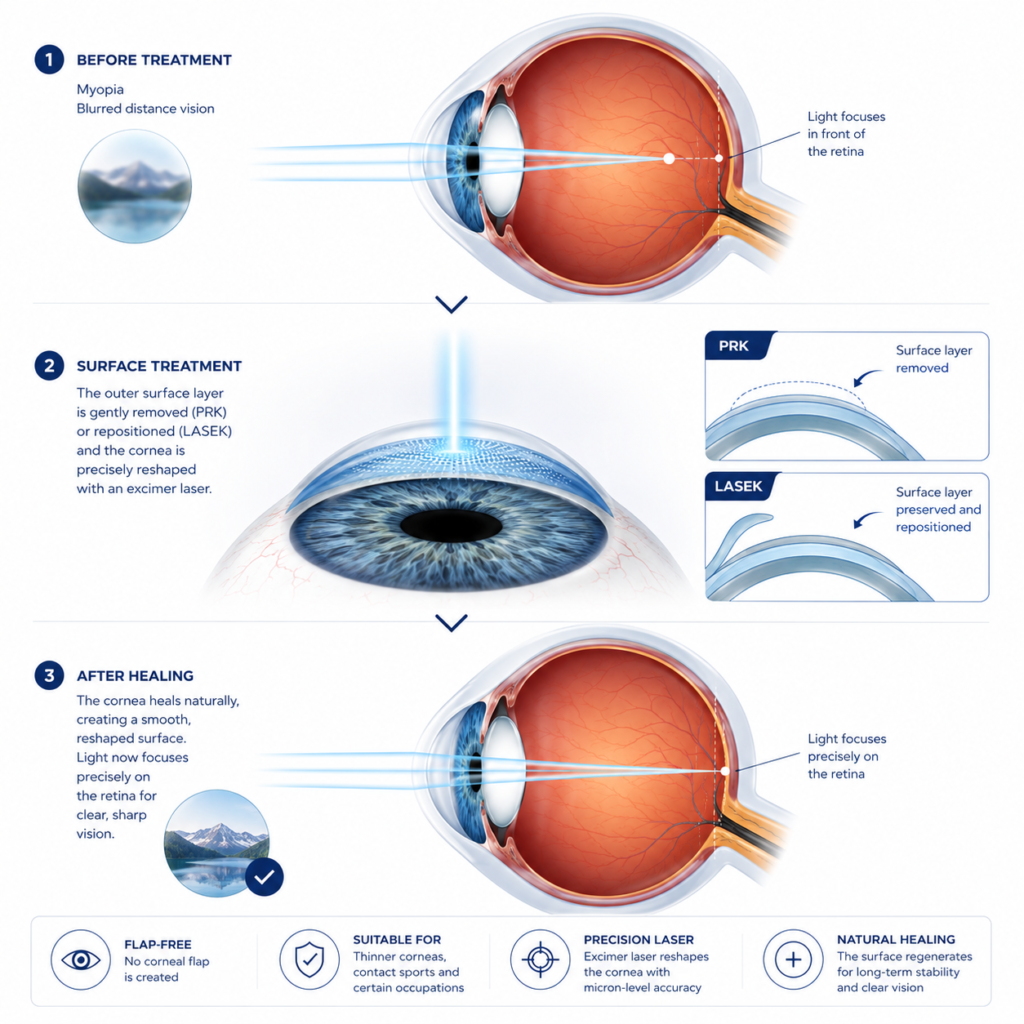
The Pros of PRK/LASEK Laser
Better Option for Some: As mentioned earlier, PRK and LASEK can be used to treat the full range of refractive errors. Furthermore, it is often a good option for patients who are unsuitable for SMILE or LASIK. For example, patients with higher prescriptions who also have thin corneas may be offered PRK/LASEK as their eyes cannot accommodate a corneal flap. Patients with co-existing eye issues such as scars or loose surface epithelium may also benefit from this treatment.
Summary
It can often seem that there is an endless list of Laser Eye Surgery options, which can make going ahead with treatment more daunting than it needs to be. But, as we have explained in this guide, things are actually much simpler than they first appear.
In reality, there are only really three Laser Eye Surgery treatments you need to be aware of and what’s more, the vast majority of patients will have either LASIK or SMILE Pro! For now, LASIK remains the most popular option; however, the new kid on the block may soon take this crown. As SMILE Pro becomes more widely available, a greater number of people may soon benefit from its less invasive nature and faster healing times.
Opting for a higher-quality Laser Eye Surgery clinic will help to make the whole process smoother and less confusing, from your initial consultation to your final aftercare appointment. By choosing London Vision Clinic, you can be sure that an experienced surgeon will always offer you the best option for you with clear and transparent prices.
"PRK and LASEK remain good options for correcting a wide range of refractive errors; however, thanks to the option of more modern techniques, these procedures are usually only offered when LASIK or SMILE is not suitable."
London Vision Clinic Team
How we Treat all Refractive Errors
“With PRK we are able to treat all refractive errors. We can treat the full range of myopia, astigmatism and long-sighted treatments, hyperopia. However, it is less predictable for hyperopia when compared to short-sightedness, myopia and astigmatism.”
Dr Glenn Carp
Treating refractive errors for millions of patients
Photo-Refractive Keratectomy (PRK) is the oldest form of Laser Eye Surgery. It has been used to successfully treat the refractive errors of millions of patients since its introduction in the 1980s. It was the first refractive surgery to apply the excimer laser, an ultra-precise alternative to the microkeratome used in traditional blade-based treatments.
After PRK, LASEK was the next major development in Laser Eye Surgery. This technique removed the need for the epithelium to completely repopulate, instead allowing for the removed epithelial tissue to be put back in place. It was initially expected that this would help to reduce post-operative side effects and speed up recovery; however, scientific studies indicate no significant difference between PRK and LASEK.
The Cons of PRK/LASEK Laser Eye Surgery
Recovery Time: The surface procedures are the most invasive forms of Laser Eye Surgery. As a result, recovery and healing times can be significantly longer than those of LASIK and SMILE. For example, it can take 7-14 days for the surface of the treatment area to heal sufficiently. This means it can take longer for patients to be able to return to normal activities.
Safety and Comfort: Like all Laser Eye Surgery procedures, PRK/LASEK treatment is generally pain-free; however, as the procedure is more invasive, patients may experience more discomfort in the days after their surgery. Still, this discomfort is usually managed effectively with painkillers and eye drops, which are provided by your clinic.
FAQs
Why would PRK or LASEK be recommended instead of LASIK or SMILE?
PRK and LASEK are often recommended when preserving as much natural corneal structure as possible is clinically important. Because both procedures are performed on the surface of the cornea and do not involve creating a corneal flap, they can be a safer and more suitable option for patients with thinner corneas, certain corneal characteristics, or specific occupational requirements. At London Vision Clinic, the choice is based on detailed imaging and structural analysis rather than on procedure popularity.
Is the visual result from PRK or LASEK different from other laser techniques?
The long-term visual outcomes of PRK and LASEK are comparable to modern flap-based laser procedures when patients are appropriately selected. The main difference lies in the healing phase rather than the final quality of vision. Once healing is complete, most patients achieve excellent clarity and stability, with results that match what can be achieved with other laser eye surgery techniques.
Why does recovery take longer with PRK or LASEK?
With PRK and LASEK, the laser treatment is applied directly to the surface of the cornea. The outer surface layer then naturally regenerates during the days following surgery. This biological healing process is what causes vision to stabilise more gradually compared with flap-based procedures. Your clinical team will guide you carefully through this recovery phase and provide a tailored treatment and review schedule to support safe and comfortable healing.
Are PRK and LASEK suitable for people with physically demanding jobs or active lifestyles?
Yes. In fact, PRK and LASEK are often preferred for patients whose work or hobbies carry a higher risk of eye impact or pressure, such as contact sports, emergency services, or military roles. Because there is no corneal flap created during treatment, these surface-based procedures remove concerns about flap displacement and can offer greater long-term peace of mind for physically active individuals.