
FREE Consultation
Multifocal Lens Implants From Our London Eye Clinic
See clearly at more than one distance.
Implantable Multifocal Lenses
As the eye’s natural focusing system becomes less flexible with age, near and intermediate vision often deteriorate gradually. For patients who already wear glasses for distance, this can quickly turn into a frustrating routine of multiple pairs or expensive varifocal lenses.
At London Vision Clinic, multifocal lens implant surgery offers a long-term solution for people who want greater visual freedom and clarity across everyday distances. Multifocal lens surgery replaces the eye’s natural lens with an advanced intraocular lens designed to provide functional vision at more than one focal range. This allows many patients to reduce their dependence on glasses for reading, screen use and distance vision as part of a single, long-term treatment.
Multifocal lens implants are commonly chosen by patients affected by presbyopia, early lens changes or cataracts, as well as by those seeking a permanent alternative to glasses or contact lenses.
What You Say About London Vision Clinic
What are Multifocal lenses?
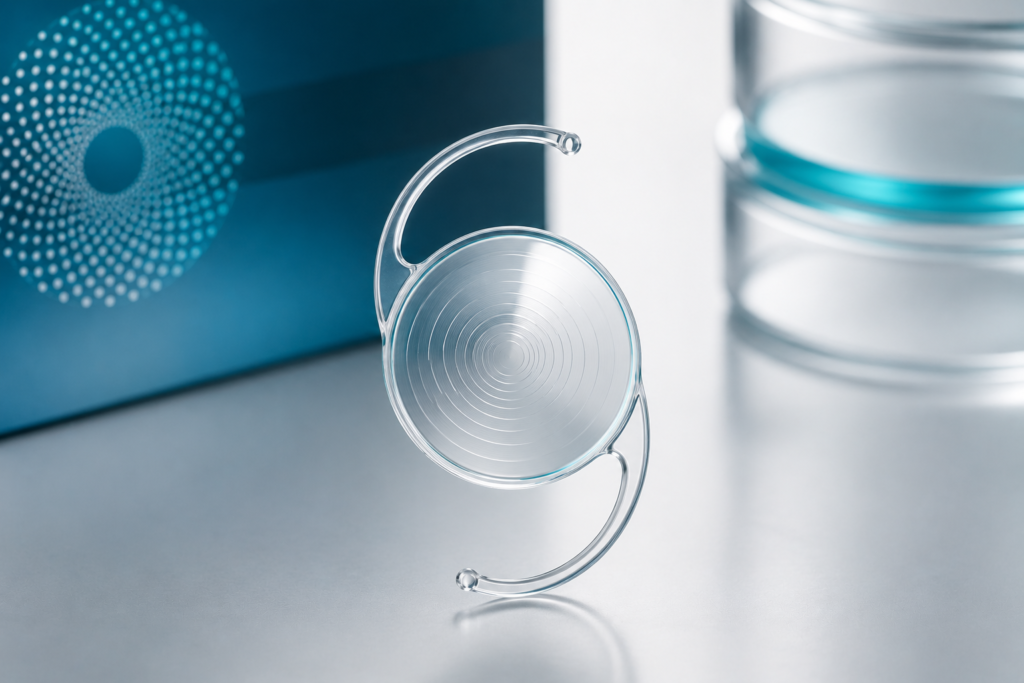
Multifocal lenses are advanced intraocular lenses designed to deliver clear vision at multiple distances by using carefully engineered optical zones within the lens itself.
Unlike monofocal lenses, which are set to focus at only one distance, multifocal lenses allow the eye to access both near and distance vision, with useful intermediate vision for many everyday activities. This makes them particularly suitable for patients who want to remain visually independent for tasks such as reading, computer work and day-to-day living.
At London Vision Clinic, the choice of multifocal lens design is guided by detailed measurements of your eyes and your individual visual needs, rather than a one-size-fits-all approach.
Features & Benefits
| Lens Feature | Patient Benefit |
|---|---|
| Multi-Range Vision Design | Supports clearer near, intermediate and distance vision throughout daily life. |
| Smooth Focus Transition | Designed to create more natural movement between reading and distance tasks. |
| Enhanced Screen Vision | Improved intermediate focus for laptops, tablets and digital lifestyles. |
| Modern Optical Materials | Premium lens materials designed for long-term clarity and visual comfort. |
| Reduced Dependence on Glasses | Many patients enjoy greater day-to-day freedom without switching between glasses. |
The procedure
Multifocal lens implant surgery is performed under local anaesthetic and is carefully planned using advanced diagnostic imaging. Before treatment, your surgeon carries out a comprehensive assessment of your eyes, including precise measurements of the cornea, pupil behaviour and the internal dimensions of the eye. This ensures that the most appropriate multifocal lens type and power are selected for you.
During the procedure, a very small opening is created at the edge of the cornea. The natural lens is gently removed using ultrasound technology (phacoemulsification). The multifocal intraocular lens is then inserted through the same opening and positioned securely inside the eye.
Multifocal lens implants can correct presbyopia alongside other refractive errors such as short-sightedness, long-sightedness and astigmatism.
Surgery typically takes around 15 to 30 minutes per eye. Most patients have one eye treated first, followed by the second eye shortly afterwards.
Benefits
Greater visual independence: Multifocal lenses are designed to support vision at more than one distance, helping many patients manage everyday tasks without relying on multiple pairs of glasses.
Long-term vision correction: Because the natural lens is replaced, the treatment provides a permanent solution for age-related lens changes.
Cataract protection: Once the natural lens has been exchanged, cataracts cannot develop in that eye in the future.
A single procedure for multiple vision problems: Multifocal lens implants can address presbyopia while also correcting existing distance or near prescription errors.
Challenges and potential risks
All eye surgery carries some degree of risk, and multifocal lens implantation is no exception. At London Vision Clinic, careful patient selection and detailed pre-operative assessment are used to minimise these risks.
Visual adaptation
Some patients notice glare, halos or reduced contrast in low-light conditions during the early period after surgery. These effects often improve as the visual system adapts to the new lens.
Surgical risks
As with any intraocular procedure, there is a small risk of infection, inflammation or other complications that could affect vision. These risks are uncommon and are discussed in detail during your consultation.
Your surgeon will explain whether multifocal lenses are suitable for your eyes and your visual expectations before any treatment is planned.
What’s the next step?
To find out whether multifocal lens implants are right for you, book your no-obligation consultation using our contact form or speak to our team on 020 7224 1005. Our specialists in central London will guide you through your options and help you choose the most appropriate vision correction pathway for your eyes.
FAQs
Will multifocal lens surgery get rid of reading glasses?
Many patients significantly reduce or completely remove their dependence on reading glasses after multifocal lens surgery. However, results can vary depending on the health of the eyes, the type of lens selected and individual visual expectations.
What is the difference between multifocal and trifocal lenses?
Multifocal lenses are designed to improve vision across multiple distances, while trifocal lenses specifically optimise near, intermediate and distance vision with dedicated focal zones. Your surgeon will recommend the most suitable option based on your lifestyle and visual needs.
How long does it take to recover from multifocal lens exchange surgery?
Most patients notice improved vision within a few days, although full visual adaptation can continue over several weeks. During recovery, eye drops and aftercare appointments help support healing and optimise visual outcomes.
Are multifocal lenses suitable for active lifestyles?
Yes. Multifocal lenses are often chosen by patients who want greater freedom during travel, work, driving, exercise and everyday activities without constantly relying on glasses or contact lenses.