If the natural lens inside your eye is removed and replaced with an artificial one, what will you actually see afterwards.
It is one of the most important questions to ask before considering lens replacement surgery, yet the answer is more interesting than simply saying “your vision should become clearer”. An artificial intraocular lens, usually called an IOL, becomes part of the optical system of your eye. The design selected can influence which distances are brought into focus, how dependent you may remain on glasses and, with some lens technologies, how you experience lights at night.
Your eyesight afterwards therefore depends on much more than the success of the operation itself. Your eye health, prescription, lens choice, visual priorities and the way your brain adapts to the new optical system all matter.
First, What Is Being Replaced?
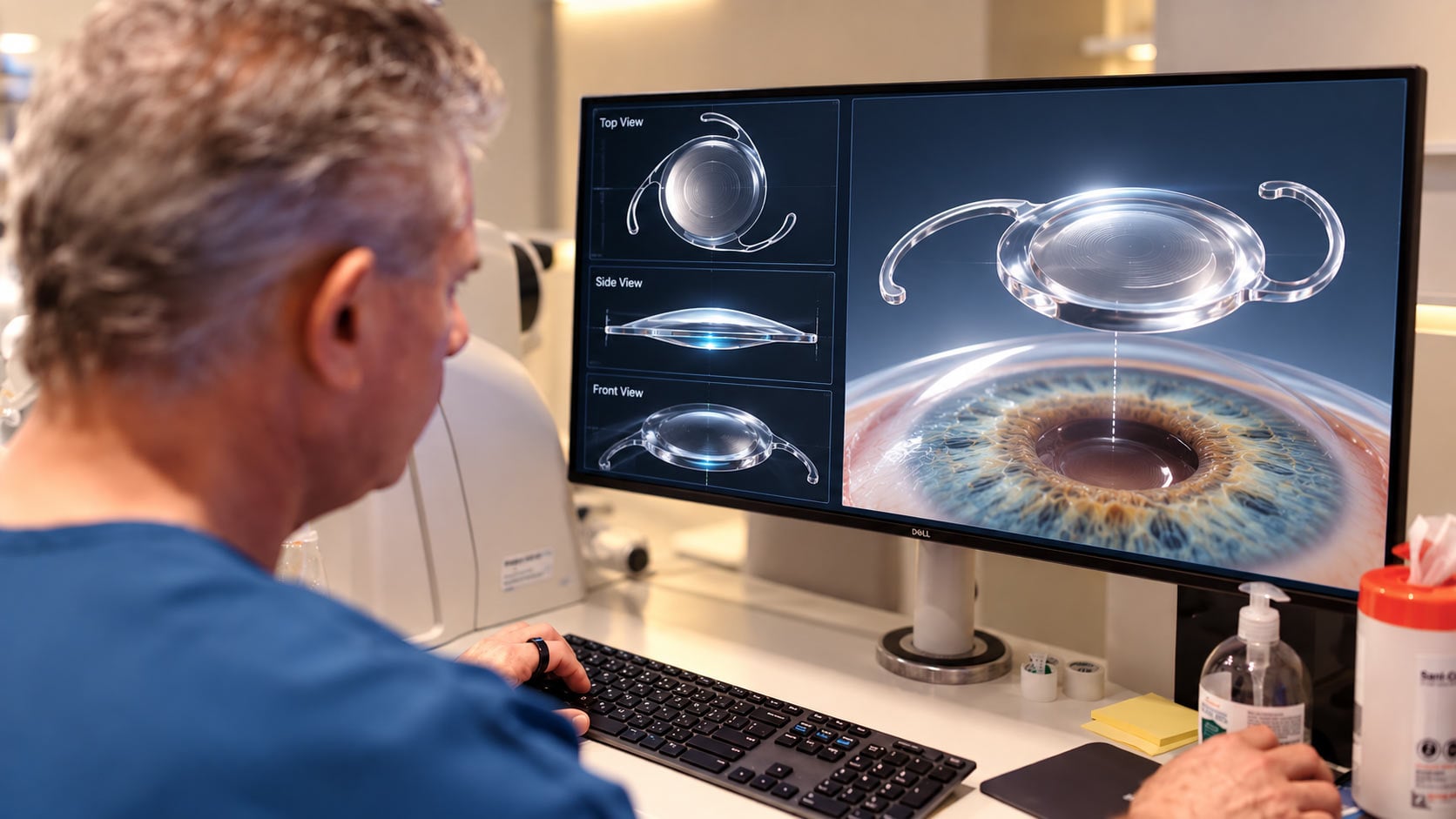
Behind the coloured iris of your eye sits a transparent natural lens. When you are young, that lens can change shape to help shift focus between different distances. Age gradually changes the equation. The natural lens becomes less flexible, contributing to presbyopia and difficulty focusing close up. Later, it can also lose transparency and develop a cataract. During lens replacement surgery, the natural lens is removed and an artificial intraocular lens is positioned inside the eye.
One Operation. Different Optical Possibilities.
The operation replaces the natural lens, but the optical design of the artificial lens helps determine the range of vision afterwards. A monofocal, EDOF and trifocal lens do not all attempt to produce vision in exactly the same way.
Your Eyesight Before and After Lens Replacement
Rather than thinking of lens surgery as a single event, it helps to see it as a visual journey.
1. Before Surgery
Your natural lens is still inside the eye. Presbyopia, refractive error, cataract formation or a combination of factors may be limiting your range or quality of vision.
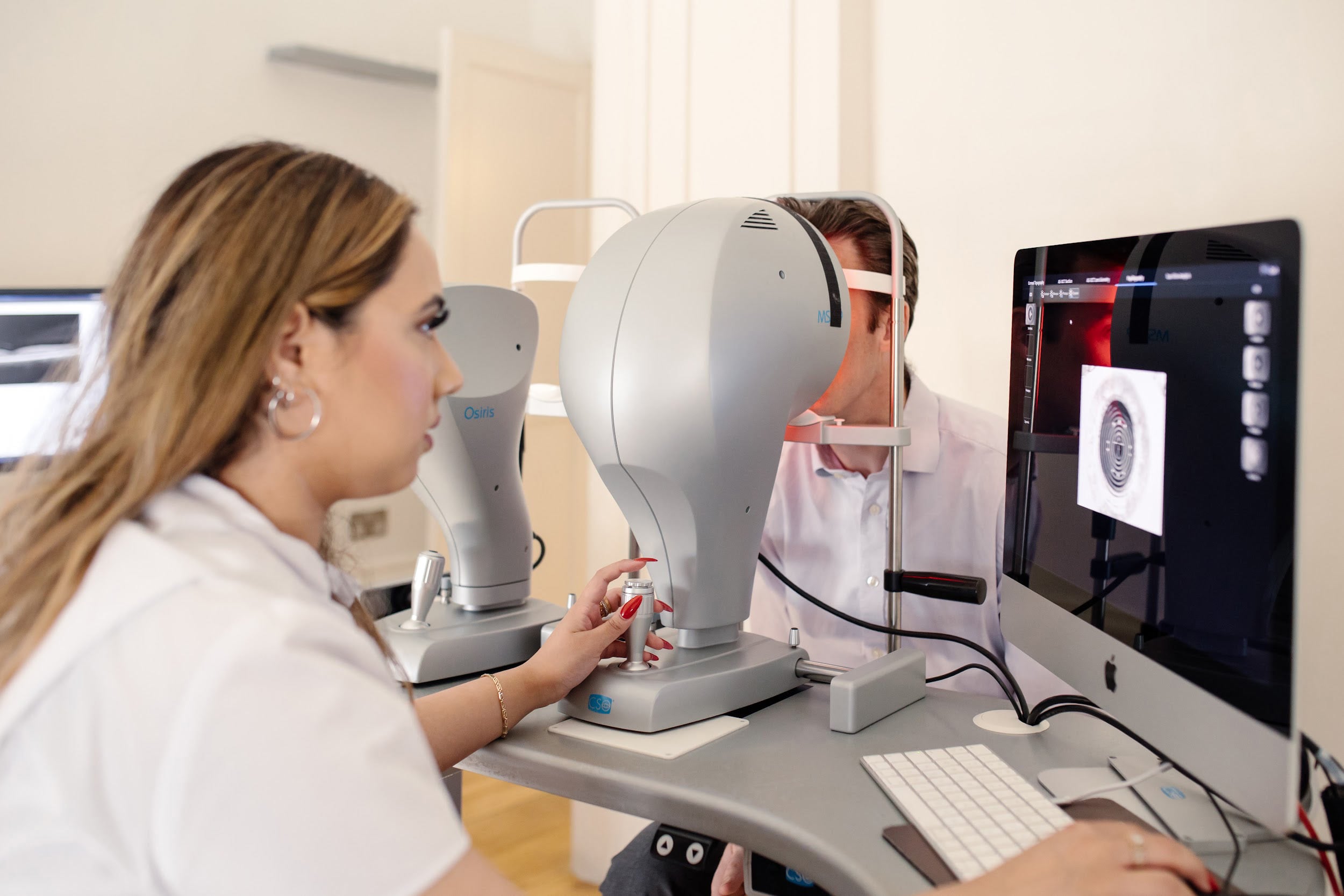
2. Your Eyes Are Measured
Detailed measurements help determine the optical power required and whether factors such as astigmatism, previous laser treatment, corneal characteristics or retinal health need additional consideration.
3. The Natural Lens Is Replaced
The natural lens is removed through a small incision and the selected intraocular lens is positioned within the lens capsule inside the eye.
4. Early Vision
Many people notice a change in vision relatively quickly, but early vision is not necessarily the final result. The eye still needs to heal and the visual system must adjust.
5. Visual Adaptation
As healing progresses, the brain becomes accustomed to the new optical arrangement. Adaptation can be particularly relevant with lenses designed to provide more than one range of focus.
6. Longer-Term Vision
The artificial lens is designed to remain inside the eye permanently. Your lens no longer undergoes the ageing changes of a natural crystalline lens, although the rest of your eye continues to age normally.
Will Everything Be in Focus After Surgery?
Not necessarily, and understanding why is central to modern lens surgery. A standard monofocal lens usually provides one principal focal point. It may, for example, be targeted towards clear distance vision, with glasses used for reading. Other lens technologies approach vision differently.
Monofocal
Think: one main destination.
Designed principally around one focal distance. Glasses may be required for other distances depending on the treatment strategy.
EDOF
Think: an extended visual range.
Extended Depth of Focus lenses aim to provide a broader continuous range, particularly across distance and intermediate vision. Reading support may still be useful for smaller print.
Trifocal
Think: three principal ranges.
Designed to provide useful near, intermediate and distance vision, with the aim of reducing dependence on spectacles across everyday activities.
None of those descriptions means one lens is universally better than another. They represent different ways of balancing visual range, quality and spectacle dependence.
What Do UK Refractive Surgeons Choose?
A 2024 study provides an interesting insight into how experienced UK refractive surgeons approach the same decision. Researchers surveyed 30 UK refractive surgeons who performed cataract surgery, refractive lens exchange and laser refractive surgery. The median refractive surgery experience among respondents was 12.5 years.
Preferred IOL for Refractive Lens Exchange
Presbyopic patient aged over 50, assuming no ocular co-pathology or ocular surface problems.
Source: Kabbani J, Price L, Patel R, Din N. BMC Ophthalmology, 2024.
The figures are useful precisely because there was no unanimous winner.
For refractive lens exchange, better overall visual outcomes were the most frequently cited reason for lens preference among the surveyed surgeons, followed by spectacle independence and fewer unwanted visual symptoms. The same study also found that lens preference changed according to the type of surgery. For a typical cataract patient, EDOF was selected by 30% of respondents, while monofocal and trifocal lenses were each selected by 20%. The findings demonstrate why lens selection should not be reduced to asking which technology is newest. Different optical priorities can lead to different choices.
Patients interested in the scientific evidence behind modern refractive treatment can also explore London Vision Clinic’s peer-reviewed scientific publications in laser and lens surgery.
Why Doesn’t Everyone Choose the Lens That Gives the Most Range?
Because range of vision is only one part of visual performance. Imagine three people considering exactly the same operation.
The Reader
Reads extensively, uses a phone frequently and places a high priority on reducing dependence on reading glasses.
The Screen User
Works on laptops and large monitors throughout the day, making intermediate vision especially important.
The Night Driver
Drives extensively after dark and may place particular importance on contrast and minimising unwanted optical effects.
All three may want greater independence from glasses, yet their definition of successful vision is not identical. That is why a consultation should involve a conversation about how you actually use your eyesight, not simply a measurement of your prescription.
Will My Brain Need to Adapt to an Artificial Lens?
It can, particularly with lenses that provide multiple or extended focal ranges. Your retina receives optical information, but seeing is ultimately a partnership between the eyes and brain. When the optical system changes, the brain may need time to become accustomed to the new visual information. Some patients become comfortable with their vision rapidly. For others, adaptation is more gradual.
Multifocal and trifocal optics can also produce visual phenomena such as halos or glare around lights. Symptoms can become less noticeable as adaptation occurs, although they do not disappear for every patient.
What Happens to Reading Vision?
The answer depends heavily on the lens and optical strategy selected. A distance-targeted monofocal lens will not recreate the accommodation of a young natural lens, so reading glasses are commonly required. Trifocal lenses are designed to provide a near focal point alongside intermediate and distance vision. EDOF lenses generally prioritise an extended range, often with particularly useful distance and intermediate vision, although fine near tasks may still require reading glasses.
Rather than asking whether an artificial lens provides “good reading vision”, it is more useful to ask:
What do you actually want to read without glasses?
A phone, restaurant menu, laptop screen, newspaper and very small print all represent different viewing distances and visual demands.
Will Colours Look Different?
Some people notice a change in colour perception or brightness after an ageing or cataractous natural lens is removed. A natural lens can gradually become yellowed or cloudy over time. Because the change happens slowly, the brain may become accustomed to the altered colour balance. Replacing a cloudy lens with a clear artificial lens can therefore make the world appear brighter or colours seem different, particularly during the early postoperative period.
Can My Eyesight Still Change After Lens Replacement?
Yes.
The artificial lens itself does not age in the same way as the natural crystalline lens, but it is only one part of your visual system. The cornea, retina, optic nerve, tear film and other structures can still change throughout life. Conditions unrelated to the implanted lens can therefore affect vision years later. A residual prescription may also remain after surgery, and individual healing can influence the final refractive result.
Can You Develop Another Cataract?
No. Once the natural crystalline lens has been removed, it cannot grow back and develop another cataract. However, a separate condition called posterior capsule opacification (PCO) can develop after lens surgery. The artificial lens sits inside a thin natural capsule. Over time, cells can make the back of that capsule cloudy, potentially causing blurred or hazy vision. PCO is sometimes described informally as a “secondary cataract”, but it is not a new cataract. When clinically appropriate, it can usually be treated with a YAG laser capsulotomy.
What Happens 10 or 20 Years After an Artificial Lens Is Implanted?
The Lens Is Permanent. Your Eyes Are Still Living Tissue.
An intraocular lens is intended to remain inside the eye long term and does not require routine replacement simply because ten or twenty years have passed.
But lens surgery does not stop the biological ageing of the rest of the eye.
Regular eye examinations remain important for monitoring retinal health, the optic nerve, eye pressure, the cornea and other structures that can influence vision later in life.
Can an Artificial Lens Ever Be Replaced?
Intraocular lenses are intended as permanent implants, so routine replacement is not expected. IOL exchange can be performed in selected circumstances, but replacing an implanted lens is another intraocular procedure and involves additional considerations and risks. The emphasis should therefore be on careful assessment and appropriate lens selection before the original operation rather than treating lens choice as something that can casually be changed later.
What If I’ve Previously Had LASIK, LASEK or Other Laser Eye Surgery?
Previous corneal laser surgery does not automatically prevent lens replacement later in life. It does, however, make preoperative planning particularly important because laser treatment changes corneal shape. Those changes can affect measurements and calculations used to determine the appropriate power of an intraocular lens. Modern biometry, corneal imaging and post-refractive calculation methods allow previously treated eyes to be assessed in much greater detail. Historical treatment records can also be useful when available.
How Do You Know What Result to Expect?
No responsible surgeon can guarantee an identical visual result for every patient. Prescription, ocular health, previous surgery, healing response, lens selection and individual visual requirements all influence outcomes.
Published clinical data can nevertheless help patients understand the evidence behind a clinic’s treatment approach. London Vision Clinic publishes its treatment results and statistics alongside its wider research programme.
Artificial Lens FAQs
Can you feel an artificial lens inside your eye?
An intraocular lens sits inside the eye rather than on its surface like a contact lens. Once the eye has healed, patients would not normally expect to physically feel the lens itself.
Does an artificial lens move when you look around?
The IOL is positioned inside the lens capsule and is intended to remain stable within the eye. Your eye itself moves normally when changing gaze.
Will I still need glasses after lens replacement?
Possibly. The likelihood depends on the lens design, refractive target, healing response and the visual task involved. Trifocal and other presbyopia-correcting technologies aim to reduce spectacle dependence, but no lens should be presented as guaranteeing complete freedom from glasses.
Does an artificial lens focus like a young natural lens?
Conventional intraocular lenses do not recreate the natural accommodation of a young crystalline lens. Different IOL technologies instead use optical strategies such as a single focal point, extended depth of focus or multiple focal points to provide useful vision across different distances.
Can an artificial lens develop a cataract?
No. Cataracts form in the natural crystalline lens, which has been removed during the procedure. Posterior capsule opacification can occur later and may cause cataract-like symptoms, but it is a different condition.
How long does an artificial lens last?
Modern intraocular lenses are designed as long-term implants and do not have a routine replacement date. The surrounding structures of the eye continue to age, so ongoing eye examinations remain important.
The Most Important Decision Is Not Simply Having Lens Surgery
Modern intraocular lens technology has made it possible to plan vision in ways that were not available to previous generations of patients. But greater choice also makes the decision more individual. A person who wants excellent reading range, someone who works across several computer screens and someone who drives extensively after dark may all approach lens selection differently. The UK surgeon survey reflects the same principle. Experienced refractive surgeons did not converge on one universal IOL for every patient. Different technologies were preferred for different optical reasons.
So the question before lens replacement is not simply:
“Which artificial lens is the best?”
A far more useful question is:
“Which visual strategy best fits my eyes and the way I live?”
That conversation, supported by detailed diagnostics and realistic expectations, is where modern lens replacement planning begins.