So, it’s time to get a new pair of glasses again… and honestly, you can’t quite believe you already need to replace the last pair.
Maybe they disappeared on a train journey or were left behind in the back of a taxi. Perhaps they finally gave up after years of wear and tear, or maybe you sat on them after a long day and heard that all-too-familiar crack.
Whatever the reason, replacing glasses rarely feels exciting. Between the inconvenience, the cost and the constant dependence on them, many people eventually start asking the same question: is there another option?
For some, the next step is contact lenses. They can feel more convenient than glasses and offer greater freedom during work, exercise and social life. But contact lenses are not always ideal as a permanent long-term solution. In some cases, overuse or poor tolerance can even contribute to additional eye health problems.
Then there is the third option: laser eye surgery.
Perhaps you know somebody who has already had treatment and will not stop talking about how life-changing it has been. Maybe you have looked into LASIK yourself before, but always found a reason to delay it. One of the most common concerns people have is whether they would actually qualify for treatment in the first place.
Modern Laser Eye Surgery Can Treat More Patients Than Ever Before
Advances in laser technology, corneal mapping and diagnostic screening mean many patients who may once have been told they were unsuitable for treatment are now discovering they have more options available than they expected.
A Suitable Option for More People Than Ever Before
Laser eye surgery has evolved dramatically over the years. Many patients who may have been told previously that they are unsuitable for treatment are often surprised to learn that this is no longer necessarily the case.
In reality, your suitability for Laser Eye Surgery can depend heavily on the clinic you visit, the technology available and the experience of the surgical team assessing your eyes.
That is why it is always worth exploring your options properly. The best way to determine whether LASIK is suitable for your eyes is through a comprehensive examination performed by a specialist ophthalmologist experienced in corneal refractive surgery.
During your consultation, your ophthalmologist will assess whether your prescription falls within a treatable range. However, this is only one part of the suitability process. Modern laser eye surgery screening involves a much deeper understanding of your eyes, including their structure, health and stability over time.
Thankfully, thanks to advances in technology and personalised treatment planning, the vast majority of patients are now suitable for some form of vision correction treatment.
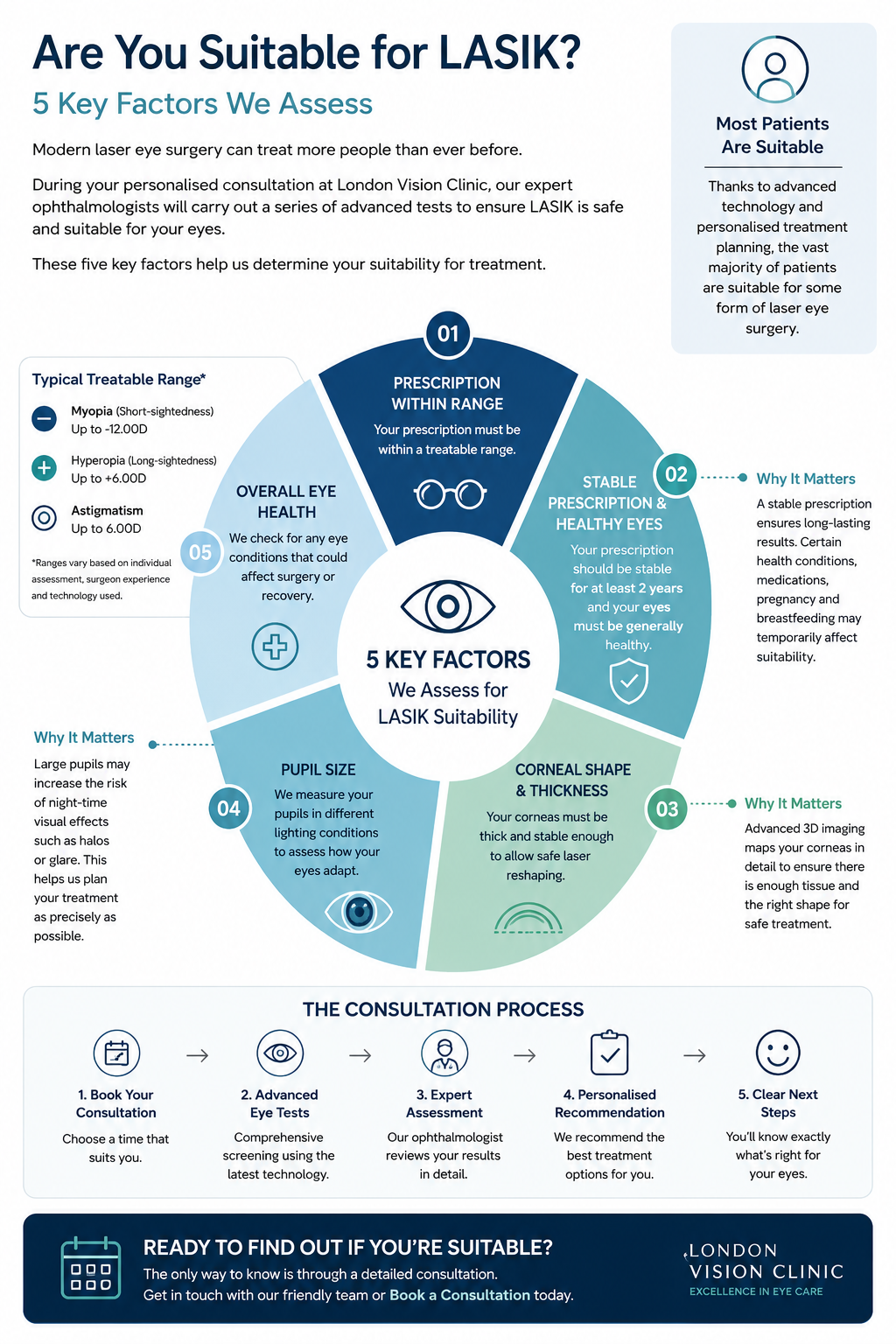
The Main Factors That Determine Your Suitability for LASIK
Is Your Prescription Within the Treatable Range?
One of the first things we assess is whether your prescription falls within a safe and effective treatment range.
Not every clinic can treat the same range of prescriptions. Clinics with access to advanced laser platforms and highly specialised expertise, such as London Vision Clinic, are often able to treat much higher prescriptions than many patients expect.
Your prescription is measured in units called diopters, which indicate the strength of correction required to focus light properly inside the eye. A minus value represents short-sightedness, while a plus value represents long-sightedness.
Myopia
Up to approximately -12.00 diopters in suitable patients.
Hyperopia
Up to approximately +6.00 diopters in suitable patients.
Astigmatism
Up to approximately 6 diopters depending on corneal stability.
Treatment ranges can vary significantly depending on the clinic, the surgeon’s experience and the technology used during planning and treatment.
Do You Have a Stable Prescription and Healthy Eyes?
In addition to being within the treatable range, your prescription also needs to be stable. In most cases, this means your prescription has not changed significantly for at least two years.
This is one reason laser eye surgery is generally not suitable for patients under the age of 18, as younger eyes are often still changing.
Prescription stability can also be influenced by factors such as hormonal changes, certain medications, general health conditions and whether you are pregnant or breastfeeding.
Fortunately, many of these factors are temporary and do not necessarily prevent treatment in the future.
What Are the Shape and Thickness of Your Corneas?
The cornea is the transparent dome-shaped surface at the front of the eye. It plays a major role in focusing light onto the retina.
Laser eye surgery works by reshaping the cornea very precisely. In order to do this safely, the cornea must be thick and stable enough to support treatment.
Unlike your glasses prescription, corneal thickness cannot be measured during a routine sight test at most opticians. This is why a detailed consultation is so important. Advanced imaging technology is used to analyse the thickness and shape of the cornea in far greater detail.
What Is Your Pupil Size?
The size of your pupils can also influence your suitability for LASIK, particularly in low-light conditions.
Our pupils naturally expand and contract depending on surrounding light levels. During your LASIK consultation, we measure how your pupils behave in different environments to help assess your risk of side effects such as halos, glare or starbursts at night.
Patients with naturally larger pupils are not automatically unsuitable for treatment, especially at clinics using modern diagnostic and laser technology. However, these measurements remain an important part of safe and personalised treatment planning.
Thinking About Laser Eye Surgery?
The only way to know which treatments may be suitable for your eyes is through a detailed consultation and screening process. At London Vision Clinic, every treatment recommendation is based on advanced diagnostics, clinical expertise and personalised planning designed around your eyes and lifestyle.
If you’d like to learn more about the suitability criteria for LASIK, get in touch with one of our friendly clinic coordinators today. Alternatively, Book a Consultation to explore all of our Laser Eye Surgery treatments.