Beyond 20/20 Eyesight
The answer lies in the difference between visual acuity and visual quality. Although 20/20 vision is widely recognised as a benchmark for clear eyesight, it represents only one aspect of how we see. At London Vision Clinic, understanding the wider characteristics of vision is an important part of assessing patients before treatment and evaluating their results afterwards. Decades of research into corneal optics, laser technology and refractive surgery have helped clinicians develop a more detailed understanding of what contributes to comfortable, functional vision.
Is 20/20 Vision the Same as Perfect Eyesight?
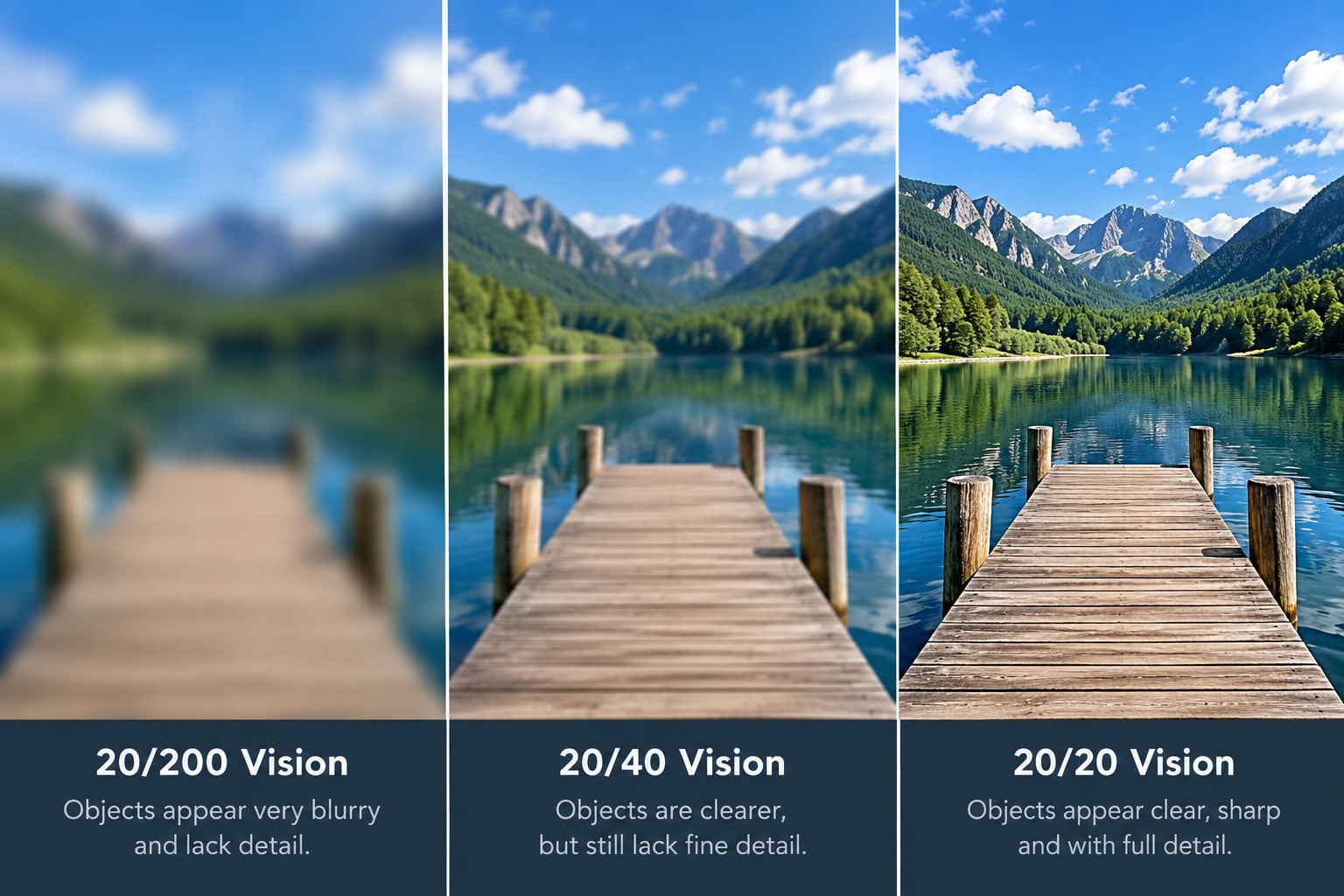
Not necessarily. The term 20/20 refers to visual acuity, which measures how clearly someone can distinguish letters or symbols at a standard distance. In the UK, the equivalent measurement is 6/6 vision, referring to a testing distance of six metres rather than twenty feet. Someone with 20/20 vision can identify details at twenty feet that a person with standard visual acuity would also recognise at that distance. However, this measurement doesn’t tell us everything about how effectively the eyes perform in different environments.
For example, a person may achieve 20/20 vision under the bright, controlled conditions of an examination room but find it more difficult to distinguish objects in dim lighting. Another may see small details clearly yet experience unwanted visual effects around bright lights. These differences can involve contrast sensitivity, optical aberrations, light scatter and the stability of the tear film. Our article explaining how visual acuity is measured explores why eye charts remain valuable, while also helping patients understand their limitations.
Visual Acuity
How clearly you can distinguish fine details, usually measured using an eye chart. Results such as 20/20 or 6/6 describe this aspect of vision.
Contrast Sensitivity
How effectively your eyes distinguish objects from their surroundings when the difference between light and dark is subtle.
Optical Quality
How accurately light is focused through the eye, including the effects of aberrations, light scatter and other optical characteristics.
Why Can Vision Quality Differ Between Patients?
Every eye has a unique optical structure. Differences in corneal curvature, pupil size, tear-film stability and the internal optics of the eye can all influence how light reaches the retina. Even when two patients have similar prescriptions, their eyes may respond differently to treatment because their starting characteristics are not identical. This is one reason why modern refractive surgery relies on detailed diagnostic measurements rather than prescription strength alone.
Healing also plays an important role. Following laser eye surgery, the cornea undergoes a period of recovery and remodelling, during which visual clarity can fluctuate. Some patients notice improvements rapidly, while others experience temporary dryness, glare or changes in sharpness before their vision stabilises. The type of procedure, the individual healing response and the condition of the ocular surface can all influence this experience.
What Are Higher-Order Aberrations?
When light enters the eye, it passes through several optical structures before reaching the retina. Ideally, light is focused in a way that produces a clear image, but small imperfections can cause some rays to focus differently from others. These imperfections are known as optical aberrations. Common refractive errors such as short-sightedness and astigmatism are classified as lower-order aberrations, while more complex distortions are described as higher-order aberrations.
Higher-order aberrations include characteristics such as spherical aberration and coma, which can influence the way light is focused, particularly when the pupils enlarge in darker conditions. Their effects may include reduced contrast or unwanted visual disturbances, although not everyone with measurable aberrations experiences noticeable symptoms. Laser eye surgery can alter the eye’s aberration profile, and modern treatment planning aims to correct the prescription while managing optical quality. The relationship between these measurements and patients’ actual visual experiences remains an important area of clinical research.
Seeing Clearly Is More Than Reading an Eye Chart
Achieving 20/20 vision is an important measure of treatment success, but visual comfort also depends on how the eyes perform in everyday situations. Driving at night, recognising faces in changing light, reading low-contrast text and maintaining stable vision throughout the day can all reveal aspects of eyesight that a standard acuity measurement does not fully capture.
Why Does Night Vision Sometimes Change After Laser Eye Surgery?
Night driving can reveal visual characteristics that are less noticeable during daylight. When the surrounding environment becomes darker, the pupils naturally enlarge to allow more light into the eyes. This can make certain optical imperfections more apparent, particularly when looking towards bright headlights or streetlights against a dark background. Some patients describe halos, glare or starburst patterns, while others notice little or no change in their night vision.
Temporary light disturbances can occur during recovery from LASIK or SMILE, particularly while the cornea and tear film are stabilising. Many improve as healing progresses, although persistent symptoms are possible and should be assessed. Factors such as pupil size, pre-existing aberrations, residual prescription and ocular surface health may all contribute. London Vision Clinic discusses these concerns in its existing guide to conditions that may affect laser eye surgery suitability.
What Does Research Tell Us About Night Vision and SMILE?
One of the advantages of studying visual quality scientifically is that researchers can investigate changes that may not be fully reflected in standard eye-chart results. At London Vision Clinic, Professor Dan Reinstein and colleagues have contributed to research examining the optical and visual outcomes of SMILE surgery, including the assessment of light disturbances. This work helps expand our understanding of how refractive procedures affect different aspects of vision, particularly in patients with higher prescriptions or astigmatism.
Research Spotlight – Measuring Light Disturbances After SMILE
Published study: Changes in Light Disturbance Analyzer Evaluation in Small Incision Lenticule Extraction (SMILE) for High Myopia and Astigmatism.
Authors: Dan Z. Reinstein, Timothy J. Archer, José Manuel González-Meijome, Ryan S. Vida and Ruchi Gupta.
Journal: Journal of Refractive Surgery, 2022.
This study examined light-disturbance measurements following SMILE treatment for patients with high myopia and astigmatism. Its relevance lies in assessing an aspect of visual performance that goes beyond conventional visual acuity, helping researchers investigate how treatment may influence the experience of bright lights against darker surroundings.
Explore this study and other peer-reviewed work in the London Vision Clinic scientific publications library.
How Does Contrast Sensitivity Affect Everyday Vision?
Contrast sensitivity describes the ability to distinguish objects from their background when differences in brightness are relatively small. It helps us recognise subtle shapes, textures and boundaries that may not be obvious under challenging lighting conditions. Someone with good visual acuity may still find certain low-contrast situations difficult, such as reading pale text, identifying steps in poor lighting or distinguishing objects in misty weather. This is why contrast sensitivity can provide additional information about functional vision.
Contrast sensitivity can be influenced by several factors, including corneal optics, the tear film, the natural lens and the retina. Refractive surgeons may consider it alongside visual acuity and other diagnostic findings when evaluating visual quality. It is particularly useful to understand that improving a patient’s prescription does not automatically eliminate every possible source of reduced contrast. A comprehensive assessment helps identify whether symptoms are related to refractive error or another aspect of eye health.
Can Dry Eyes Affect Vision Quality After LASIK or SMILE?
Yes. The tear film forms the eye’s first optical surface, and its stability is essential for maintaining consistently clear vision. When the tear film becomes uneven or breaks up too quickly, light may scatter irregularly as it enters the eye. This can produce intermittent blurring, fluctuating sharpness or discomfort, even when a patient’s underlying prescription has been successfully corrected. Some people notice these effects particularly during prolonged screen use, reading or time spent in air-conditioned environments.
Dry eye symptoms can develop or temporarily increase following laser eye surgery, although the likelihood and duration vary between individuals and procedures. Careful pre-operative assessment, appropriate treatment planning and post-operative management are therefore important. Our guide to dry eyes and laser eye surgery explains why these symptoms occur and how they may be managed during recovery.
How Do Surgeons Measure Vision Quality Beyond 20/20?
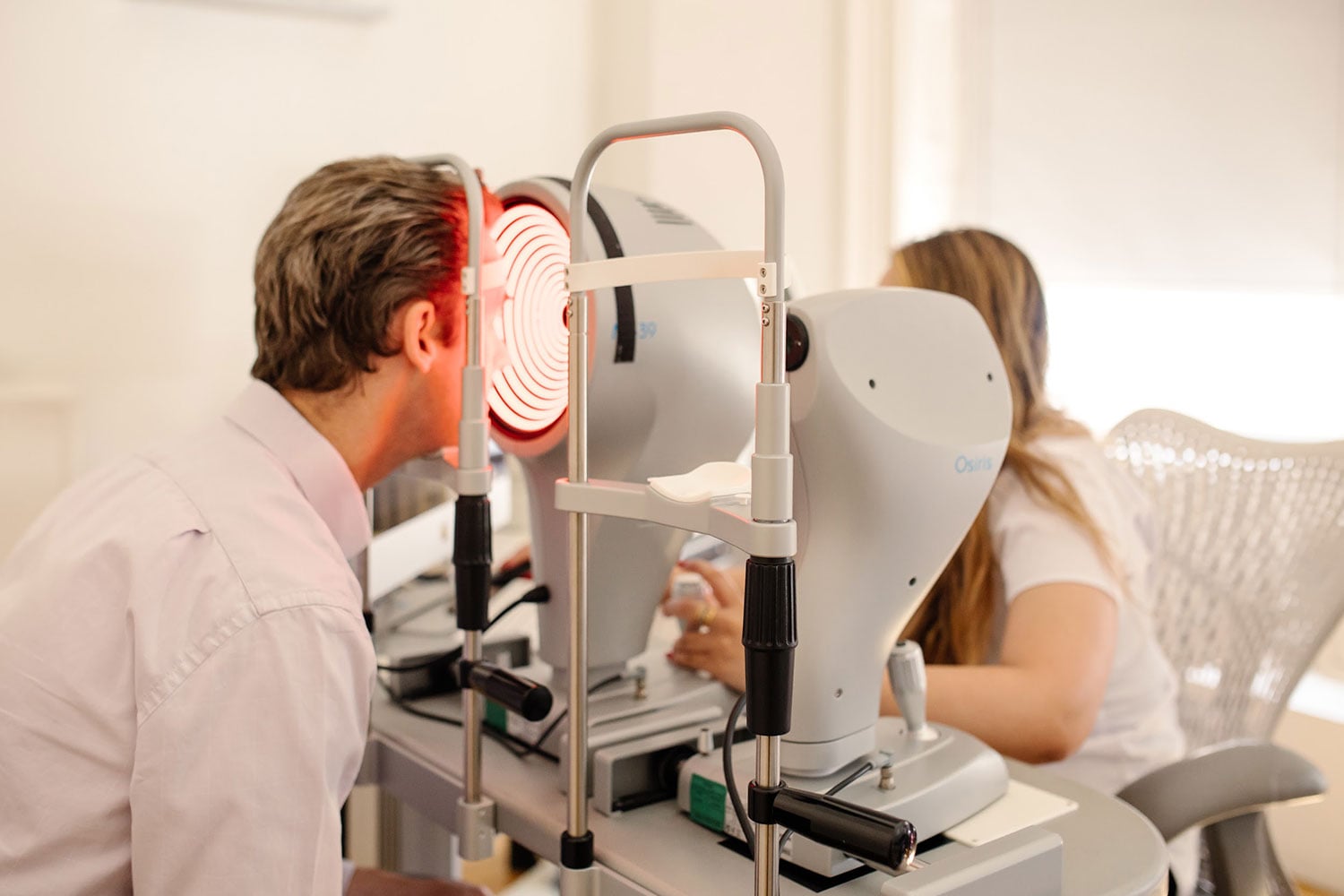
Modern diagnostic technology allows clinicians to examine several characteristics of vision rather than relying exclusively on a standard eye chart. Depending on the patient’s needs, testing may include corneal topography, tomography, wavefront analysis, contrast sensitivity assessment and measurements of light scatter or visual disturbances. Each test provides a different perspective on how the eye focuses light and how its optical structures may influence visual performance. When considered together, these findings can support more individualised treatment planning.
London Vision Clinic’s diagnostic technology includes equipment designed to investigate aspects of visual quality such as straylight and light disturbances. These measurements can be useful when assessing patients who report glare, halos or other symptoms that are not fully explained by their visual acuity. They also help clinicians investigate changes in vision during follow-up appointments where appropriate. You can explore the wider range of diagnostic technology used at London Vision Clinic and how it contributes to patient assessment.
Can Advanced Laser Technology Improve Vision Quality?
Advances in laser eye surgery have focused not only on correcting prescriptions but also on improving precision, treatment consistency and the understanding of corneal optics. Modern femtosecond and excimer laser systems allow surgeons to perform highly controlled procedures, while increasingly sophisticated imaging helps identify the individual characteristics of each eye. These developments have contributed to improvements in refractive surgery, although the quality of a patient’s final vision still depends on factors beyond the laser itself.
Research into treatment centration, optical zones, corneal aberrations and surgical planning continues to refine how refractive procedures are performed. London Vision Clinic has contributed to this research through studies involving LASIK and SMILE, including investigations of visual outcomes using newer generations of laser technology. Its article on the next generation of SMILE laser eye surgery explores how clinical results are being evaluated as surgical systems evolve.
What Does London Vision Clinic’s Research Tell Us About Visual Outcomes?
Clinical research is particularly valuable when it examines more than one measure of success. A treatment may be assessed for how closely patients achieve their intended prescription, how many lines they can read on an eye chart, how stable their results remain and whether they experience changes in other aspects of visual performance. These measurements help researchers identify the strengths and limitations of different techniques. They also provide evidence that can inform future treatment planning and patient discussions.
Professor Dan Reinstein and colleagues have published extensively on refractive surgery outcomes, corneal optics and diagnostic technology. Their work includes investigations of higher-order aberrations following LASIK, light disturbances after SMILE and the relationship between treatment parameters and visual recovery. These studies do not mean every patient will experience the same result, but they contribute to a growing evidence base for understanding how refractive surgery affects the eye.
Research Spotlight – Understanding Optical Aberrations
Published study: LASIK-Induced Aberrations: Comparing Corneal and Whole-Eye Measurements.
Authors: Marine Gobbe, Dan Z. Reinstein and Timothy J. Archer.
Journal: Optometry and Vision Science, 2015.
This research investigated the relationship between optical aberrations measured at the corneal level and those measured across the whole eye following LASIK. The distinction is important because visual quality depends on the combined optical system, not simply the shape of the cornea in isolation.
The study forms part of London Vision Clinic’s wider published research into laser eye surgery outcomes.
What Should Patients Expect from Their Vision After Laser Eye Surgery?
For many patients, the most meaningful improvement after laser eye surgery is the ability to carry out everyday activities without relying on glasses or contact lenses. Reading road signs, recognising faces at a distance, enjoying outdoor activities and waking up with clearer unaided vision can all make a substantial difference to daily life. However, recovery is individual, and some patients experience temporary fluctuations in visual clarity while their eyes heal. Achieving a good result involves understanding both the expected benefits and the possible limitations of treatment.
It is also important to distinguish between normal recovery symptoms and changes that require further assessment. Dryness, glare and temporary blurring can occur during healing, but persistent or worsening symptoms should be discussed with the treating clinic. Following prescribed aftercare instructions and attending scheduled appointments allows the clinical team to monitor recovery and address concerns. For a closer look at this process, our complete guide to recovery and post-operative care explains what patients may experience at different stages.
Why Personalised Assessment Matters More Than a Single Number
Visual acuity remains one of the most important ways of measuring eyesight, but it should not be confused with a complete description of visual quality. Two patients can achieve the same eye-chart result while experiencing differences in contrast, night vision, comfort or visual stability. Recognising these differences helps surgeons investigate symptoms more effectively and gives patients a clearer understanding of what successful treatment may involve.
At London Vision Clinic, research, diagnostic assessment and individual treatment planning form part of the approach to refractive surgery. The objective is not simply to achieve a particular number on an eye chart, but to determine whether treatment is appropriate and to help patients understand the range of possible visual outcomes. Because excellent eyesight is about more than what you can read at twenty feet. It’s about how comfortably and confidently you see the world around you.
Frequently Asked Questions About Vision Quality After Laser Eye Surgery
Understanding visual outcomes can help patients make informed decisions about laser eye surgery. These questions address some of the differences between visual acuity, visual quality and the changes that may occur during recovery.
Is 20/20 vision considered perfect eyesight?
No. 20/20 vision indicates standard distance visual acuity, but it does not measure every aspect of eyesight. Contrast sensitivity, night vision, colour perception and optical quality can all influence how someone experiences their vision. It is possible to achieve 20/20 while still noticing glare, halos or other visual symptoms.
Can you have better than 20/20 vision after laser eye surgery?
Yes. Some patients achieve visual acuity better than 20/20, such as 20/16 or 20/15, following laser eye surgery. However, results depend on individual eye characteristics, treatment suitability and the healing response. Better visual acuity does not necessarily mean every aspect of visual quality will be superior.
Why might night vision be different after LASIK or SMILE?
Night vision can be influenced by pupil size, optical aberrations, tear-film stability and changes associated with corneal healing. Some patients experience temporary glare, halos or starbursts after surgery, particularly around bright lights in dark environments. These symptoms often improve during recovery, although persistent disturbances are possible and should be assessed by an eye care professional.
How long does vision quality take to stabilise after laser eye surgery?
Many patients notice an improvement in visual acuity relatively quickly, but the time required for vision to stabilise varies according to the procedure and individual healing response. Dryness, fluctuations in clarity and light sensitivity may continue for several weeks or longer. Your surgeon can explain the expected recovery pattern for your treatment and assess any symptoms that persist or worsen.
Published for 2026
This article draws on published ophthalmic research and London Vision Clinic’s scientific publications to explain visual acuity, optical quality and the factors influencing vision after laser eye surgery. Individual outcomes vary, and treatment suitability must be established through a comprehensive clinical assessment.