What Is the Difference Between ICL Surgery and Clear Lens Exchange?
ICL surgery and Clear Lens Exchange are both lens-based forms of vision correction, but they work in fundamentally different ways.
ICL surgery adds an artificial lens to the eye while preserving the natural crystalline lens. Clear Lens Exchange removes the natural lens and replaces it with an artificial intraocular lens. This difference affects who each treatment may suit, the visual functions retained after surgery and the risks that must be considered.
At London Vision Clinic, treatment is recommended only after a comprehensive examination of your prescription, eye anatomy, natural lens, age, lifestyle and long-term visual needs.
ICL Surgery and Clear Lens Exchange at a Glance
| Key Difference | ICL Surgery | Clear Lens Exchange |
|---|---|---|
| Natural lens | The natural lens remains in place. | The natural lens is removed and replaced. |
| Lens position | The ICL sits behind the iris and in front of the natural lens. | The new intraocular lens sits inside the natural lens capsule. |
| Natural focusing | Natural focusing ability is preserved, although it will still reduce with age. | Natural focusing ability is lost when the crystalline lens is removed. |
| Common suitability | Often considered for younger patients with higher prescriptions and sufficient space inside the eye. | More commonly considered when natural near focus has reduced or lens changes are developing. |
| Presbyopia | A standard distance-correcting ICL does not prevent presbyopia or remove the future need for reading glasses. | Different IOL designs may provide distance vision alone or a broader range of focus. |
| Future cataracts | Cataracts can still develop because the natural lens remains in the eye. | A cataract cannot subsequently develop in a natural lens that has been removed. |
| Future adjustment | The ICL can potentially be removed or exchanged if clinically necessary. | Removing the natural lens is permanent, although the implanted IOL can sometimes be exchanged. |
What Is an Implantable Collamer Lens?
An Implantable Collamer Lens, commonly known as an ICL, is a small, flexible lens made from Collamer®, a biocompatible lens material. Unlike a contact lens, which rests on the surface of the eye, an ICL is surgically positioned inside the eye.
During ICL surgery, the lens is placed behind the iris and in front of the natural crystalline lens. The natural lens is not removed, allowing younger patients to retain their existing ability to change focus between different distances.
The ICL provides additional focusing power inside the eye. It is intended to remain in place long term, but it can potentially be removed or exchanged if the patient’s circumstances or clinical needs change.
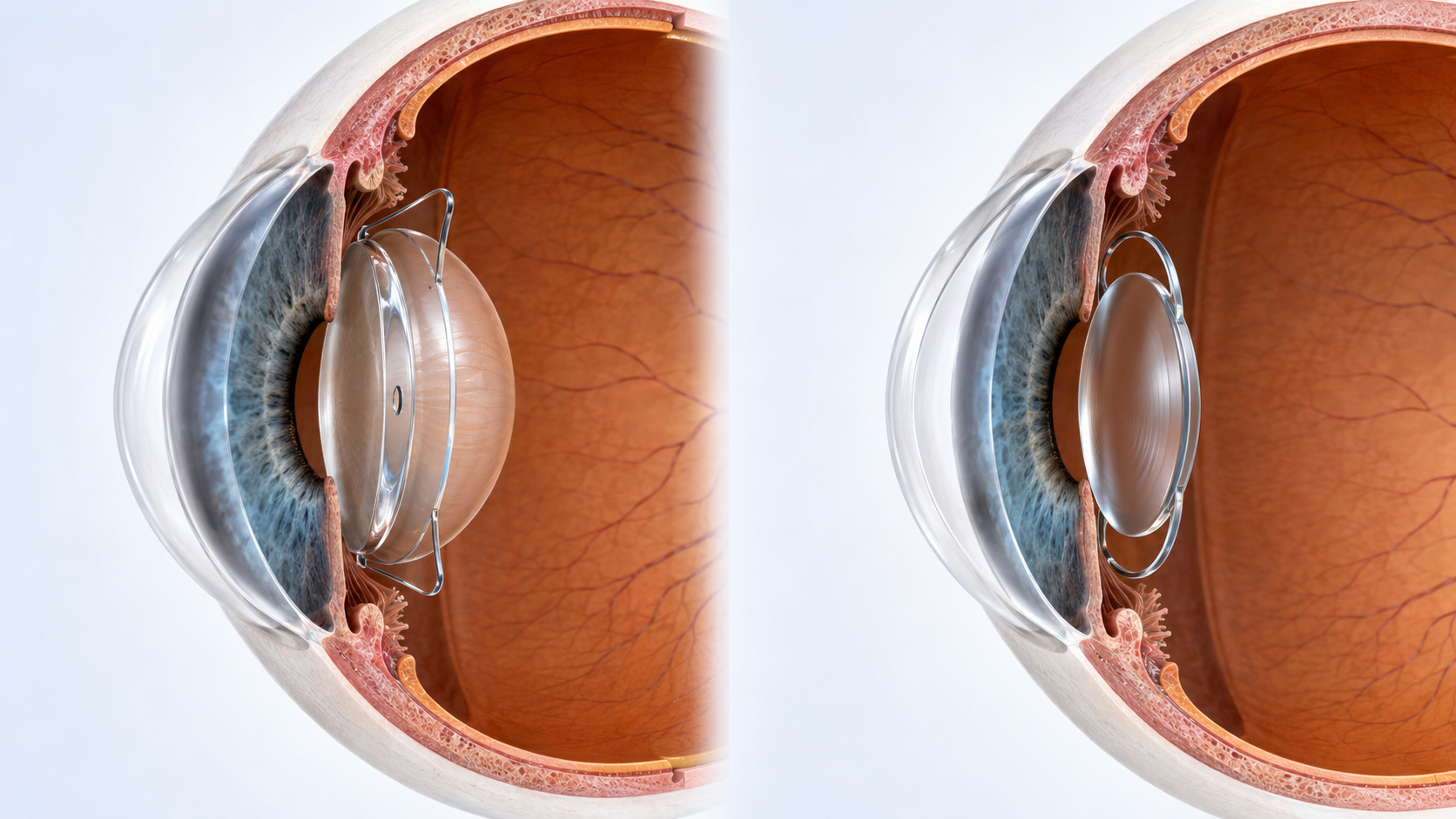
This image shows the fundamental difference between ICL surgery and Clear Lens Exchange. With ICL surgery, an additional lens is positioned behind the iris while the eye’s natural lens remains intact. With Clear Lens Exchange, the natural lens is removed and replaced with an artificial intraocular lens.
Which Prescriptions Can ICL Surgery Correct?
ICL surgery is most commonly used to correct myopia, or short-sightedness, with or without astigmatism. Other phakic lens options may be available for different prescriptions, depending on the patient, lens design and regional product availability.
A standard distance-correcting ICL does not treat the underlying ageing process that causes presbyopia. A patient may therefore require reading glasses later in life, even if their distance vision remains clear.
Prescription strength is only one part of ICL suitability. The surgeon must also consider:
- The depth of the anterior chamber
- The space available behind the iris
- The health of the cornea and its endothelial cells
- The size and anatomy of the eye
- The condition of the natural crystalline lens
- The patient’s age and long-term visual needs
Accurate lens sizing is particularly important because it affects how the ICL sits inside the eye and the amount of space between the implanted lens and the natural lens. This space is known as the vault.
Professor Reinstein Explains Which Prescriptions Can Be Treated With ICL Surgery
What Is Clear Lens Exchange?
Clear Lens Exchange, also known as Refractive Lens Exchange or RLE, removes the eye’s natural crystalline lens and replaces it with an artificial intraocular lens.
The artificial lens is positioned inside the capsular bag that previously held the natural lens. Its optical power is selected to correct the patient’s prescription and support their visual requirements.
Because the natural lens is removed, the eye loses its remaining natural ability to adjust focus. The type of artificial lens selected therefore becomes an important part of treatment planning.
Which Lens Options Are Used for Clear Lens Exchange?
There are several types of intraocular lens, each designed to provide a different visual outcome:
- Monofocal lenses provide clear focus at one principal distance, usually distance vision.
- Toric lenses include correction for astigmatism.
- Multifocal and trifocal lenses divide light between more than one focal distance.
- Extended Depth of Focus lenses are designed to extend the range of functional vision.
- Light Adjustable Lenses allow elements of the prescription to be refined after implantation using controlled light treatments.
No artificial lens recreates every characteristic of a young natural crystalline lens. Lens selection must balance the desired range of vision with optical quality, night vision, lifestyle and the possibility that glasses may still be helpful for some activities.
Who May Be Better Suited to ICL Surgery?
ICL surgery may be considered for patients who:
- Have a higher prescription that is unsuitable for corneal treatment
- Have healthy natural lenses and useful natural focusing ability
- Have sufficient internal space to accommodate an ICL safely
- Meet the required corneal endothelial cell criteria
- Want to preserve their natural crystalline lenses
ICL surgery is often considered in younger patients because preserving the natural lens also preserves their remaining accommodation. However, age alone does not determine suitability.
Who May Be Better Suited to Clear Lens Exchange?
Clear Lens Exchange may be considered when:
- The natural lens has already lost much of its focusing flexibility
- Presbyopia has become a significant concern
- The prescription or internal anatomy makes ICL surgery unsuitable
- Early lens changes are affecting the quality of vision
- A suitable artificial lens could provide a more appropriate long-term solution
Removing a healthy natural lens requires careful consideration, particularly in younger patients who still have useful accommodation. In highly myopic eyes, the surgeon must also assess retinal health and discuss the risks associated with intraocular lens surgery.
How Is Clear Lens Exchange Different From Cataract Surgery?
Clear Lens Exchange and cataract surgery use essentially the same surgical technique. In both procedures, the natural lens is removed and replaced with an artificial intraocular lens.
The difference is the reason for surgery:
Clear Lens Exchange
The natural lens is still clear, but it is replaced primarily to correct a refractive error or address age-related focusing needs.
Cataract Surgery
The natural lens has become cloudy and must be removed to restore clearer vision.
Once the natural lens has been removed during Clear Lens Exchange, it cannot later develop a cataract. However, avoiding possible cataract surgery in the future should not be the sole reason for choosing lens replacement. The immediate benefits and risks must be considered against all suitable alternatives.
Important Considerations Before Lens Surgery
Vision Can Still Change Over Time
Both ICL surgery and Clear Lens Exchange can provide long-lasting vision correction, but neither procedure can prevent every future change to the eyes.
The cornea, retina and other structures can continue to change with age. An ICL patient will also continue to experience natural ageing of the crystalline lens, including presbyopia and potentially cataract formation.
Following Clear Lens Exchange, a small residual prescription or later refractive change may mean that glasses, contact lenses or an additional refining procedure are useful. The result should therefore be described as long-term vision correction rather than a guarantee of permanently perfect vision.
Glare, Halos and Contrast Sensitivity
Some intraocular lens designs can produce optical effects such as glare, halos or reduced contrast sensitivity, particularly in low-light conditions. These effects are more commonly associated with lenses that provide multiple focal points, although experiences vary considerably between patients.
The choice of lens should reflect how much the patient values near vision, distance clarity, night driving and freedom from glasses. A lens that suits one person’s lifestyle may not be the best option for another.
ICL Sizing and Long-Term Monitoring
ICL sizing influences the lens position and post-operative vault. London Vision Clinic uses advanced internal imaging and research-led planning to personalise ICL selection. You can read more about this work in our guide to personalised ICL sizing and research.
Post-operative appointments are also important after either procedure. These allow the clinical team to monitor healing, vision, eye pressure and the relationship between the implanted lens and the surrounding structures.
How Do We Decide Between ICL Surgery and Clear Lens Exchange?
The decision is not based on prescription strength alone. Your surgeon will consider:
- Your natural lens: Is it clear, healthy and still able to change focus?
- Your internal eye anatomy: Is there enough space to position an ICL safely?
- Your prescription: Which treatment and lens designs are available for the required correction?
- Your age and visual needs: Is preserving accommodation particularly important?
- Your eye health: Are the cornea, retina, optic nerve and other structures healthy?
- Your lifestyle: What balance of distance, intermediate and near vision would suit you?
- The risk-to-benefit balance: Does the anticipated visual benefit justify intraocular surgery?
The central difference is simple: ICL surgery preserves your natural lens, while Clear Lens Exchange replaces it. The right recommendation depends on which approach offers the most appropriate balance of visual benefit, safety and long-term planning for your individual eyes.
To learn more about your vision correction options, contact one of our clinic coordinators or book a consultation at London Vision Clinic.