Inside every human eye is a remarkable piece of natural optical engineering. The crystalline lens, positioned just behind the iris, helps focus light onto the retina and, when we are young, changes shape to bring objects at different distances into focus. It is effectively the eye’s adjustable focusing system, working alongside the cornea to create the images we see. As we grow older, this natural lens gradually becomes less flexible. Reading becomes more difficult, close-up objects require greater effort to focus on and, eventually, the lens may become cloudy as a cataract develops. Modern ophthalmology has developed an extraordinary range of artificial lenses to address these changes, but not all artificial lenses work in the same way or are designed to solve the same problem.
Some are engineered to provide exceptionally clear vision at one distance. Others distribute light between several focal points, extend the range of useful focus or allow a surgeon to refine the prescription after implantation. Understanding these differences is important because choosing an artificial lens is not simply about replacing something that no longer works. It is about deciding how you want your vision to function for years to come.
What Exactly Is an Artificial Eye Lens?
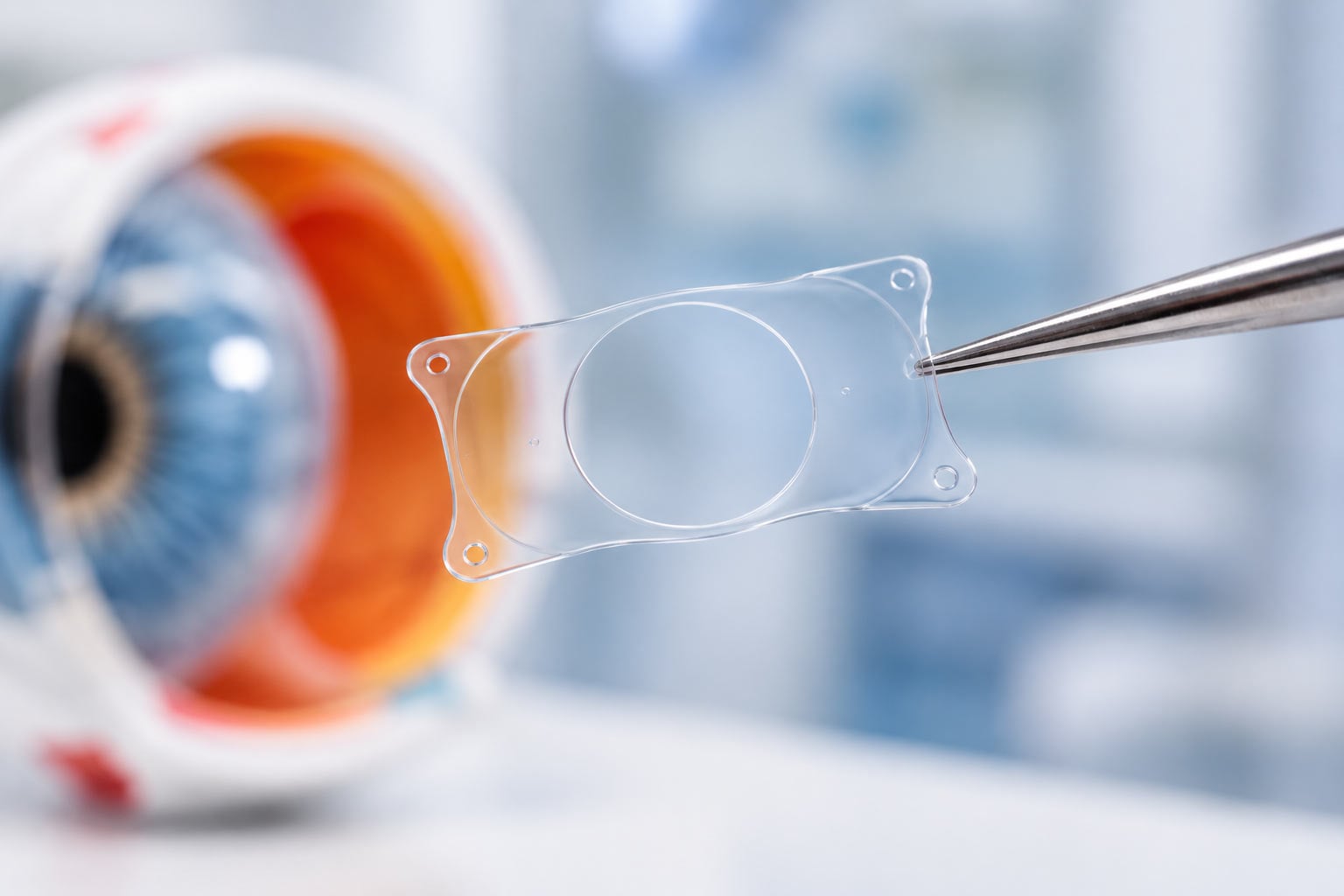
An artificial eye lens, medically known as an intraocular lens or IOL, is a small optical implant designed to focus light inside the eye. Most modern IOLs are made from biocompatible materials, such as acrylic or silicone, and are carefully manufactured to provide a specific optical power. Unlike ordinary contact lenses, they are implanted surgically and do not need to be removed, cleaned or replaced every day.
In cataract surgery or refractive lens exchange, the natural crystalline lens is removed and replaced with an artificial lens, usually positioned within the original lens capsule. The capsule is a thin, transparent structure that helps support the implant. The replacement lens cannot change shape like a young natural lens, so its optical design determines which distances will be clearest after surgery. There is also another category of implantable lens, known as a phakic intraocular lens, which is positioned inside the eye without removing the natural crystalline lens. Implantable Collamer Lenses (ICLs) belong to this category. London Vision Clinic explains the distinction in its article on ICL surgery versus clear lens exchange.
The Research Perspective
The interesting thing about artificial lenses is that they do not all attempt to reproduce natural vision in the same way. Some concentrate optical energy into one sharp focal point, while others distribute or extend that energy to create a wider range of useful vision. The trade-off between optical quality, depth of focus and independence from glasses is central to understanding why several different lens technologies exist.
What Are the Different Types of Artificial Eye Lenses?
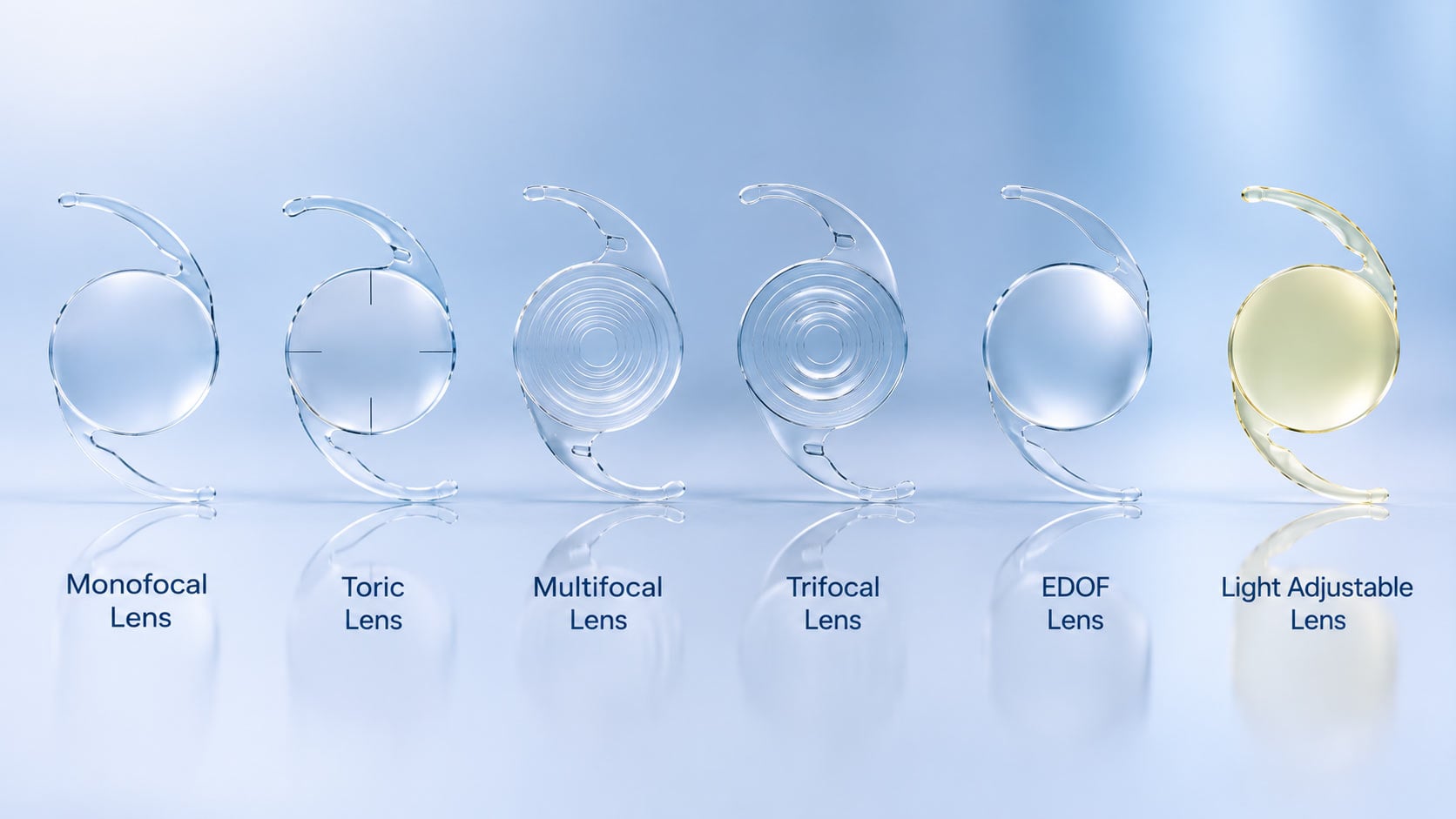
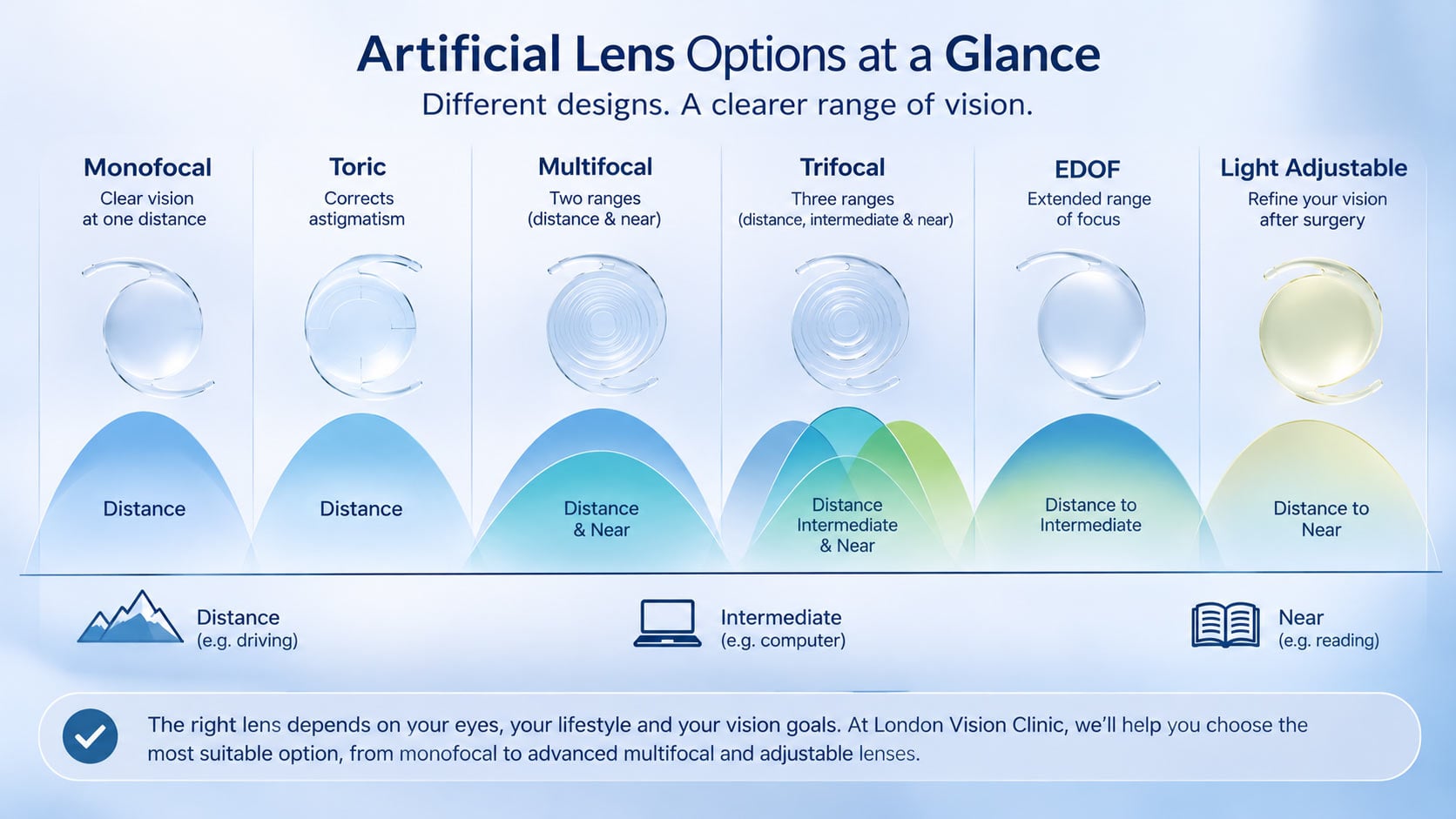
Artificial lenses can be grouped according to how they focus light and which visual problems they are intended to address. The main categories include monofocal, toric, multifocal, trifocal, extended depth of focus and light adjustable lenses. Some of these categories overlap. For example, a trifocal lens may also incorporate toric correction for astigmatism, while certain extended depth of focus lenses use multifocal optical principles.
The table below provides a practical comparison of the principal options used in modern cataract and refractive lens surgery.
| Artificial Lens | How It Works | What It Corrects | Treatment Options |
|---|---|---|---|
| Monofocal Lenses | Provides a single principal focal distance, usually selected for clear distance vision. | Short-sightedness or long-sightedness. Reading glasses are often still needed. | Commonly used in cataract surgery and selected lens replacement procedures. |
| Toric Lenses | Uses different optical powers across specific meridians to compensate for corneal astigmatism. | Regular astigmatism alongside short- or long-sightedness, depending on the lens design. | Available as an option within private cataract treatment. |
| Multifocal Lenses | Distributes incoming light between multiple focal ranges to reduce dependence on glasses. | Presbyopia and refractive errors, providing useful vision at more than one distance. | Explore advanced implantable lens surgery. |
| Trifocal Lenses | Provides three principal focal ranges for near, intermediate and distance vision. | Presbyopia, short- or long-sightedness and, with toric designs, astigmatism. | Learn about trifocal lens exchange surgery. |
| EDOF Lenses | Extends the range of useful focus, generally prioritising distance and intermediate vision. | Presbyopia and refractive errors. Additional glasses may be needed for fine print. | Discuss options through LVC’s implantable lens treatments. |
| Light Adjustable Lenses | Allows selected refinements to the lens power after implantation using controlled light treatments. | Residual refractive error, including suitable astigmatism, within the technology’s adjustment range. | Explore Light Adjustable Lens treatment at LVC. |
Clinical note: Lens selection depends on eye health, prescription, corneal measurements and visual priorities. Some categories overlap, and not every lens design is appropriate for every patient. Your surgeon will explain the expected benefits, limitations and risks of each option.
Monofocal Lenses
When Optical Clarity Takes Priority
Monofocal lenses are among the most established forms of intraocular lens technology. Their design provides one principal focal distance, commonly selected for clear distance vision. A patient receiving monofocal lenses for cataract surgery may therefore see well when driving or watching television but still need reading glasses for books, phones and other close-up activities. There is a good optical reason for this approach. By concentrating light primarily at one focal distance, monofocal lenses can provide strong image quality without the multiple focal images associated with many presbyopia-correcting designs. This may be especially valuable for patients who prioritise contrast sensitivity, night driving or predictable distance vision.
Monofocal lenses can also be used in a monovision arrangement, where the two eyes are targeted at different distances. However, this requires careful assessment of binocular vision and the patient’s ability to tolerate the difference between the eyes.
Toric Lenses
Correcting Astigmatism Inside the Eye
Astigmatism occurs when the eye’s optical surfaces have different focusing powers in different directions, often because the cornea is shaped more like a rugby ball than a football. Instead of forming one precise focal point, light is focused differently across separate meridians, producing blur or distortion. A standard spherical artificial lens may correct short- or long-sightedness without fully addressing this additional optical error.
Toric intraocular lenses are designed with different powers in different meridians to compensate for regular corneal astigmatism. They must be aligned accurately within the eye because rotation away from the intended axis reduces their effectiveness. Toric correction can be incorporated into several lens designs, including monofocal and certain presbyopia-correcting lenses. For patients undergoing cataract surgery, the ability to address both the cloudy natural lens and astigmatism in one treatment can be particularly useful. London Vision Clinic discusses these options within its private cataract surgery service.
Multifocal and Trifocal Lenses
More Than One Distance in Focus
The natural lens of a young eye changes shape to adjust its focus. Most artificial lenses cannot reproduce this physical movement, so multifocal technologies take a different approach. They use carefully engineered optical structures to distribute incoming light between more than one focal range, helping the visual system access useful information at different distances.
Trifocal lenses are a specific type of multifocal lens designed to support near, intermediate and distance vision. These ranges correspond to familiar activities such as reading a message, working at a computer and looking across the road. They can be particularly relevant for patients experiencing presbyopia who want to reduce their dependence on several pairs of glasses. However, distributing light between multiple focal points involves optical compromises. Some patients experience halos around headlights, glare or reduced contrast sensitivity, particularly in low-light conditions. The aim is not simply to provide the greatest number of focal points, but to establish whether the benefits of a wider visual range outweigh those compromises for the individual patient.
London Vision Clinic offers trifocal lens exchange surgery and has published further information about the development of modern trifocal technology and the importance of personalised lens selection.
EDOF Lenses
Extending the Range of Useful Vision
Extended Depth of Focus lenses, commonly shortened to EDOF, take a different optical approach. Rather than creating three distinct focal ranges in the manner of a conventional trifocal lens, they aim to extend the region over which useful focus is maintained. The result is generally intended to provide good distance vision and a broader intermediate range, which may be particularly valuable for computer work, dashboards and everyday activities.
EDOF designs vary considerably.Some use diffractive optical structures, while others use different methods of manipulating the wavefront or depth of focus. Consequently, their performance in low light, contrast sensitivity and near vision cannot be assumed to be identical.Patients who place a high priority on intermediate vision may find EDOF lenses worth discussing, although small print and sustained close reading may still require spectacles. The differences between EDOF, monofocal and trifocal technologies are also explored in London Vision Clinic’s article What Happens to Your Eyesight After an Artificial Lens Is Implanted?.
Light Adjustable Lenses
Can Your Prescription Be Refined After Surgery?
One of the more interesting developments in artificial lens technology is the ability to adjust the optical power after the lens has been implanted. A Light Adjustable Lens contains a photosensitive material that responds to a carefully controlled pattern of ultraviolet light. Following the initial healing period, the surgeon can make selected adjustments to the lens power based on the patient’s measured vision and treatment goals. This approach is different from choosing a conventional fixed-power lens and relying entirely on preoperative calculations. It provides an additional opportunity to refine the refractive result after the eye has begun to recover. The adjustments do not make the lens capable of natural accommodation, and the achievable range of correction remains subject to the specific technology and the patient’s measurements.
Light Adjustable Lens treatment also involves a series of postoperative appointments and the use of prescribed UV-protective eyewear until the adjustment process is complete. London Vision Clinic includes this technology within its advanced implantable lens surgery offering.
Which Artificial Lens Is Best for Your Lifestyle?
The question patients often ask is which artificial lens is the best. From a research perspective, the more useful question is what the lens needs to achieve. A patient who spends several hours reading fine print may have different priorities from someone who drives regularly at night, works across multiple computer monitors or values maximum contrast when viewing distant objects.
Driving and Distance Vision
Monofocal lenses may appeal to patients prioritising high-quality distance vision and fewer multifocal optical effects.
Computers and Screens
EDOF lenses may offer a useful balance of distance and intermediate vision, depending on the design.
Reading and Everyday Freedom
Trifocal lenses are designed to reduce reliance on glasses across near, intermediate and distance activities.
Prescription Refinement
Light Adjustable Lenses provide an opportunity to refine selected refractive outcomes after implantation.
These are examples of different visual priorities, not fixed recommendations. A patient’s corneal measurements, retinal health, existing eye conditions, prescription and ability to adapt to different optical designs are equally important. In some circumstances, a simpler lens may provide a better overall result than a more complex design.
How Long Do Artificial Eye Lenses Last?
Modern artificial intraocular lenses are designed to remain inside the eye for the rest of a patient’s life. They do not wear out in the same way as contact lenses, and routine replacement is not generally necessary. Once implanted, the lens is intended to provide a stable optical correction over many years. However, the fact that an artificial lens is designed to last a lifetime does not mean vision can never change again. The cornea, retina and other structures of the eye continue to age, while conditions unrelated to the implant can affect visual quality. A patient may also develop changes in their remaining prescription or require treatment for an unrelated eye condition.
Artificial lenses can occasionally require repositioning, exchange or removal because of complications, incorrect power, lens movement or dissatisfaction with the visual result. These situations are not routine and must be evaluated individually because exchanging an implanted lens involves additional surgery and risk.
Can an Artificial Lens Become Cloudy or Develop a Cataract?
A cataract develops when the natural crystalline lens becomes cloudy. Once that natural lens has been removed during cataract surgery or refractive lens exchange, it cannot develop another cataract. Nevertheless, some patients notice their vision becoming cloudy months or years after successful surgery, which can understandably create confusion. A common explanation is posterior capsule opacification, or PCO. This occurs when residual lens epithelial cells cause the thin capsule behind the artificial lens to become cloudy. The artificial lens itself is not necessarily damaged, and PCO can often be treated with a short YAG laser capsulotomy procedure when clinically appropriate.
True opacification of an artificial lens can also occur, but it is a different and less common problem. Any new reduction in vision should be examined rather than assumed to be PCO, as other eye conditions may produce similar symptoms.
What Are the Advantages and Disadvantages of Artificial Lens Surgery?
Artificial lens surgery can provide long-term optical correction and, in the case of cataract treatment, restore clarity by removing a cloudy natural lens. Depending on the lens selected, patients may also experience reduced dependence on distance, computer or reading glasses. The ability to incorporate astigmatism correction and select different optical designs makes modern lens surgery highly individualised. There are also important limitations. Removing a clear natural lens eliminates any remaining natural accommodation, and lens exchange is an intraocular procedure with risks that differ from those associated with corneal laser surgery. Potential complications include infection, inflammation, retinal detachment, macular swelling, raised eye pressure, lens positioning problems and unwanted visual effects such as glare or halos. The level of risk varies with the patient, procedure and lens design. For this reason, artificial lens surgery should not be viewed as automatically preferable to laser vision correction. The decision requires a careful assessment of expected benefits, visual priorities, eye health and the alternatives available.
Why Does London Vision Clinic Offer Different Artificial Lens Technologies?
Modern vision correction is not a single procedure with a universal solution. A patient with cataracts and significant astigmatism has different optical requirements from someone experiencing early presbyopia or a person seeking greater independence from reading glasses. Offering a range of artificial lens technologies allows the clinical team to consider these differences rather than attempting to fit every patient into one treatment pathway.
London Vision Clinic combines detailed diagnostic imaging, biometric measurements and consultant-led treatment planning with experience in laser and lens-based refractive surgery. Its research-led approach, associated with Professor Dan Reinstein and the clinic’s wider clinical team, emphasises understanding the complete optical system of the eye before recommending a procedure. Importantly, the availability of artificial lenses does not mean that lens replacement is always the preferred treatment. For selected patients with presbyopia, PRESBYOND Laser Blended Vision and other presbyopia treatment options may offer an alternative that preserves the natural crystalline lens. The most appropriate recommendation depends on the patient’s age, anatomy, existing lens changes and visual requirements.
How Is the Correct Artificial Lens Selected?
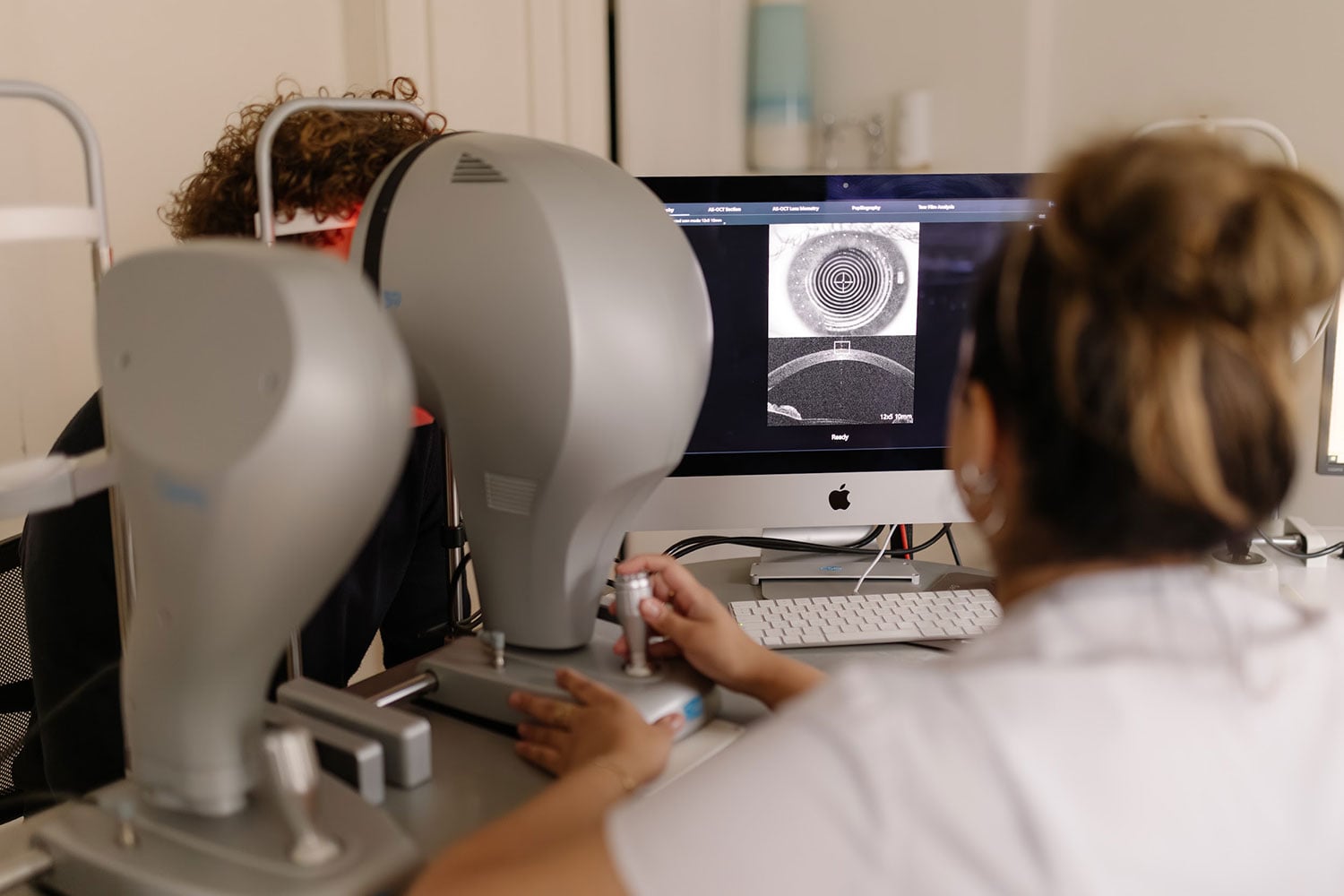
Lens selection begins with understanding the patient’s eyes and the way they use their vision. Detailed measurements assess the curvature and optical properties of the cornea, the length of the eye, the amount of astigmatism and the health of the retina. These findings are combined with the patient’s prescription, lifestyle and expectations to calculate an appropriate lens power and determine which optical designs may be suitable.
Modern biometric calculations are highly sophisticated, but no formula can eliminate every source of uncertainty. Healing responses, effective lens position and individual optical characteristics can influence the final result. This is why a comprehensive assessment, careful surgical planning and structured aftercare are essential parts of the process. Patients can learn more about these stages in London Vision Clinic’s patient journey, which explains the consultation, diagnostic testing, treatment planning and follow-up process.
Frequently Asked Questions About Artificial Eye Lenses
What are artificial eye lenses made from?
Most modern artificial intraocular lenses are manufactured from biocompatible acrylic or silicone-based materials. Many are flexible, allowing them to be folded for insertion through a small surgical incision. The material, optical design and surface properties vary between lens models.
How does an artificial lens stay in place?
In cataract surgery and refractive lens exchange, the artificial lens is usually positioned within the natural lens capsule. Small supporting structures called haptics help hold it in place. Other types of implantable lenses, including ICLs, are supported differently within the eye.
Can an artificial eye lens be replaced?
Yes, an artificial lens can sometimes be exchanged or repositioned if a clinical problem develops or the optical result is unsuitable. However, lens exchange is a further intraocular operation with its own risks, so it is not routinely undertaken simply to change lens technology.
Is artificial lens surgery the same as cataract surgery?
Artificial lenses are commonly implanted during cataract surgery, but they can also be used in refractive lens exchange when a patient does not have a visually significant cataract. The surgical principles are similar, although the reasons for treatment and the balance of benefits and risks differ.
Will I ever need glasses again after artificial lens surgery?
That depends on the lens type, treatment target and individual visual outcome. Monofocal lenses generally provide one principal focal distance, while trifocal and other presbyopia-correcting lenses aim to reduce dependence on glasses across a wider range. No artificial lens guarantees complete spectacle independence in every situation.
Can artificial lenses correct astigmatism?
Yes. Toric intraocular lenses can compensate for suitable forms of regular corneal astigmatism. Toric correction may be available within different optical designs, including certain monofocal, trifocal and extended depth of focus lenses.
Who may not be suitable for artificial lens replacement?
Suitability depends on the overall health of the eye, the expected benefit and the risks of surgery. Certain retinal diseases, uncontrolled eye conditions, significant corneal abnormalities or other clinical findings may limit the choice of lens or make surgery inadvisable. Patients with substantial remaining natural accommodation also need to understand what would be lost through clear lens exchange.
Understanding the Technology Behind Clearer Vision
Artificial lenses represent decades of progress in optical engineering, biomaterials and ophthalmic surgery. Their designs have become increasingly sophisticated, but the underlying objective remains straightforward: to focus light accurately and provide the most useful vision possible for the individual patient. Whether that means one exceptionally clear focal distance, a broader range of focus or greater independence from reading glasses depends on the person behind the prescription.
At London Vision Clinic, access to different artificial lens technologies forms part of a wider approach to personalised vision correction. By combining specialist diagnostics, surgical experience and an understanding of the advantages and limitations of each optical design, the clinical team can help patients make informed decisions about the treatment most appropriate for their eyes.