Astigmatism is one of those eye conditions that sounds more complicated than it really is. Millions of people live with it, often without knowing exactly what causes their blurred vision. Some notice that distant road signs never appear completely sharp, while others find that letters seem slightly stretched, headlights produce unwanted streaks or their eyes become tired after prolonged reading. Glasses and contact lenses can compensate for these differences, but many people eventually ask a more permanent question: can laser eye surgery actually correct astigmatism?
The answer is yes. Modern laser eye surgery can correct many forms of regular astigmatism, either on its own or alongside short-sightedness and long-sightedness. However, the science behind achieving an accurate correction is more sophisticated than simply reshaping an uneven cornea. The surgeon must understand not only the strength of the astigmatism, but also its orientation, the underlying structure of the eye and how the cornea is expected to respond to treatment. These considerations have been the subject of extensive research involving Professor Dan Reinstein, Timothy Archer and their colleagues at London Vision Clinic.
What Actually Happens Inside an Eye with Astigmatism?
To understand how laser eye surgery corrects astigmatism, it helps to understand how the eye normally focuses light. The cornea, the transparent surface at the front of the eye, provides much of the eye’s focusing power. In an eye with little or no astigmatism, light is focused relatively evenly, helping produce a clear image on the retina. With astigmatism, the eye has different focusing powers in different directions, meaning light does not converge into a single sharp focus in the same way.
Astigmatism is often described by comparing the cornea to a rugby ball rather than a football. Although this is a useful illustration, the reality is more complex because astigmatism can arise from the cornea, the internal lens or a combination of both. It can also occur alongside short-sightedness or long-sightedness, creating a prescription that requires correction in more than one direction. Understanding these differences is essential when planning refractive surgery.
Regular Focusing
When the eye’s focusing power is appropriately balanced, light can be brought into a clear focus on the retina. This supports sharp vision when no significant refractive error is present.
Astigmatic Focusing
Different focusing powers across the eye produce different focal positions. This can cause blurred, distorted or stretched vision, even when objects are otherwise within a comfortable viewing distance.
These simplified illustrations represent the difference between more uniform and astigmatic focusing. Actual corneal shape and optical behaviour are more complex, which is why detailed diagnostic measurements are necessary before treatment.
How Does Laser Eye Surgery Correct Astigmatism?
Laser eye surgery works by changing the shape of the cornea so that incoming light is focused more accurately. When correcting astigmatism, the treatment must account for the difference in focusing power between the eye’s principal meridians. Rather than removing an identical amount of tissue across the treatment area, the laser follows a carefully calculated pattern designed to reduce the unwanted cylindrical correction. The objective is to create a more balanced optical surface while preserving the health and structural integrity of the cornea.
LASIK, PRK/LASEK and SMILE all approach corneal reshaping differently, but each can be used to correct suitable forms of astigmatism. LASIK and PRK/LASEK use an excimer laser to reshape the cornea, whereas SMILE uses a femtosecond laser to create a precisely shaped lenticule within the corneal tissue. The choice of procedure depends on the prescription, corneal measurements, ocular surface health and other individual factors. Patients exploring these differences may find our article on what happens before, during and after SMILE laser eye surgery particularly helpful.
Why Is the Axis of Astigmatism So Important?
One of the most interesting aspects of astigmatism correction is that the prescription contains information about both strength and direction. In addition to the spherical measurement, which describes short-sightedness or long-sightedness, an astigmatic prescription includes a cylinder value and an axis. The cylinder describes the difference in focusing power between the eye’s principal meridians, while the axis specifies their orientation. Both measurements are important because an otherwise accurate correction applied at the wrong orientation may leave residual astigmatism.
Imagine attempting to correct an unevenly shaped surface without knowing which direction the unevenness runs. The amount of correction might be appropriate, but its placement would be incorrect. Astigmatism surgery presents a similar challenge, although the calculations are considerably more sophisticated. Small differences in treatment alignment can become particularly important when correcting higher amounts of astigmatism, which is why accurate measurements, surgical planning and treatment positioning matter.
Astigmatism Is About Strength and Direction
A prescription containing astigmatism usually includes three important measurements. Together, they help describe how the eye focuses light and provide essential information for planning a correction.
For anyone unfamiliar with these measurements, London Vision Clinic’s article on understanding your eye prescription provides a useful introduction to the terminology used during an eye examination.
What Does Clinical Research Tell Us About Astigmatism Correction?
Astigmatism presents an interesting challenge for researchers because a successful result cannot be described by prescription strength alone. The surgeon must consider how much astigmatism was present before treatment, how much was intended to be corrected, the direction of that correction and the amount remaining afterwards. Comparing these measurements allows researchers to assess the accuracy of surgical techniques and identify opportunities for improvement. It also helps distinguish between a treatment that reduces astigmatism and one that achieves the intended correction with greater precision.
Professor Dan Reinstein and Timothy Archer have contributed to research examining how astigmatism outcomes should be measured and reported. In 2014, alongside J. Bradley Randleman, they published a standard for reporting astigmatism outcomes following refractive surgery. This work helped establish a consistent framework for evaluating astigmatism correction, making it easier to interpret and compare surgical results. Such standards matter because reliable clinical evidence depends on measuring outcomes in a consistent and meaningful way.
Establishing Standards for Astigmatism Outcomes
Study: JRS Standard for Reporting Astigmatism Outcomes of Refractive Surgery.
Authors: Dan Z. Reinstein, Timothy J. Archer and J. Bradley Randleman.
Published: Journal of Refractive Surgery, 2014.
This publication addressed how astigmatism outcomes should be presented and evaluated in refractive surgery research. By establishing consistent reporting methods, it supports more meaningful comparisons of surgical accuracy and helps clinicians interpret results beyond a simple before-and-after prescription.
Can SMILE Correct High Astigmatism?
SMILE has become an important area of refractive surgery research, particularly as laser technology and treatment planning have evolved. Unlike LASIK, which involves creating a corneal flap before reshaping the underlying tissue, SMILE creates a small lenticule within the cornea that is removed through a limited incision. The lenticule is designed to account for the patient’s refractive error, including the cylindrical correction required for astigmatism. As with other procedures, the accuracy of the treatment depends on appropriate patient selection and precise surgical planning.
Research involving Professor Reinstein and colleagues has investigated SMILE for patients with high myopia and astigmatism. A study published in the Journal of Refractive Surgery in 2022 examined the correction of high myopia with astigmatism, contributing evidence about the procedure’s refractive and visual outcomes in this patient group. Other research has investigated how treatment planning and alignment influence the correction of astigmatism during SMILE. These studies help clinicians understand the capabilities and limitations of the technique rather than assuming that every patient with a high prescription will achieve the same result.
Research Spotlight – SMILE for High Myopia and Astigmatism
Study: Small Incision Lenticule Extraction (SMILE) for the Correction of High Myopia with Astigmatism.
Authors: Dan Z. Reinstein, Timothy J. Archer, Ryan S. Vida, Glenn I. Carp, Julia F. R. Reinstein, Theo McChesney and Joseph G. Potter.
Published: Journal of Refractive Surgery, May 2022.
The study examined visual and refractive outcomes following SMILE in eyes with high myopia and astigmatism. It contributes to the evidence used to evaluate how effectively the procedure can correct more complex prescriptions and helps inform clinical discussions about suitability and expected outcomes.
Why Does Corneal Mapping Matter Before Surgery?
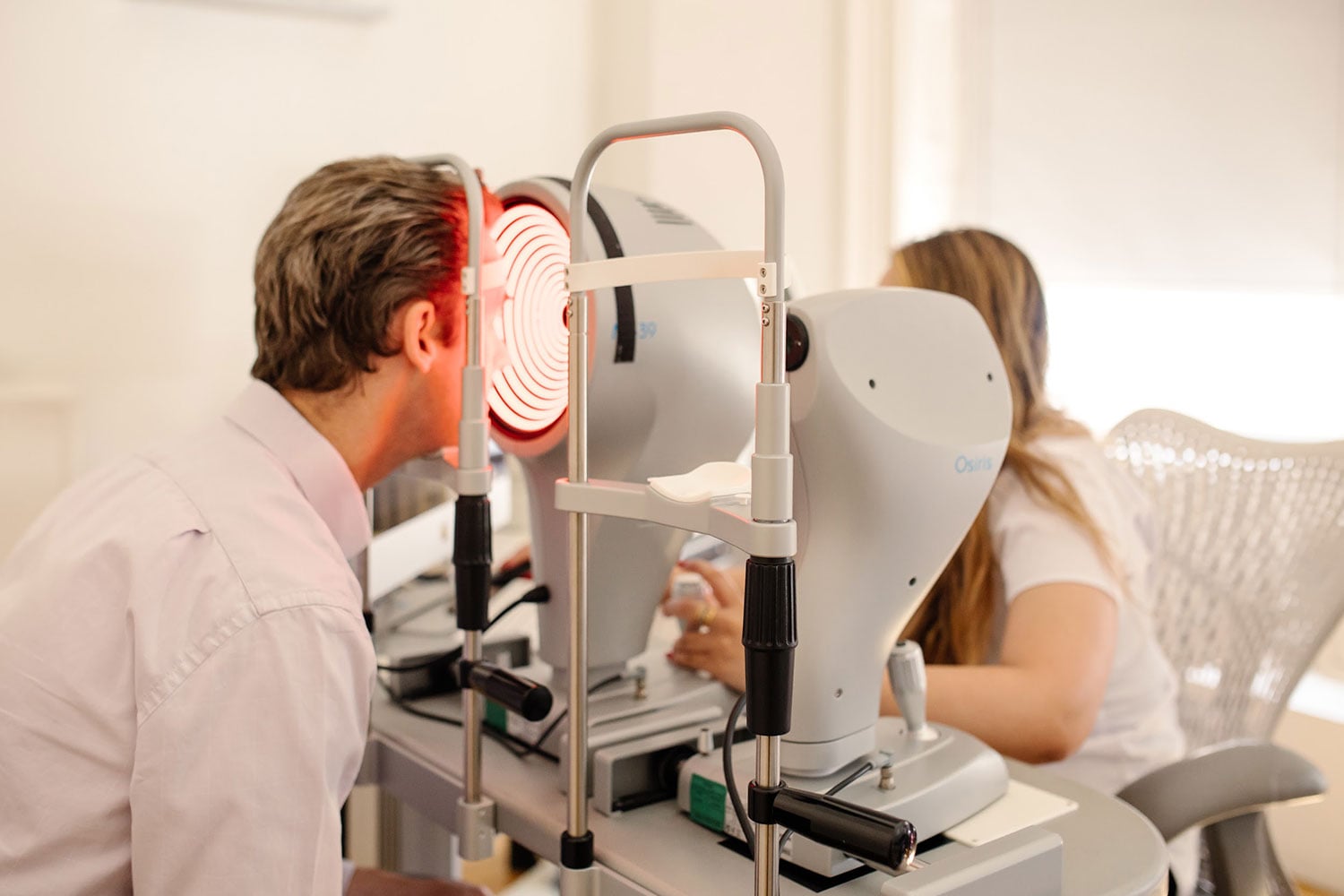
Although a glasses prescription provides essential information, it cannot describe every characteristic of the eye. Corneal topography and tomography allow clinicians to examine the shape and structure of the cornea in greater detail, identifying patterns that may influence treatment planning or suitability. These examinations are particularly important when investigating irregular astigmatism, where the cornea may not have the relatively symmetrical shape associated with ordinary refractive astigmatism. Conditions such as keratoconus can produce progressive corneal irregularity and may make conventional laser vision correction inappropriate.
Advanced imaging can also help surgeons distinguish between astigmatism arising from the cornea and astigmatism influenced by the eye’s internal optics. This distinction becomes relevant when the measured corneal astigmatism differs from the cylinder found during a subjective refraction. London Vision Clinic’s research has explored these relationships, including the influence of ocular residual astigmatism on treatment planning. For patients, the practical message is straightforward: a detailed examination helps establish not only whether astigmatism can be corrected, but also which approach may be appropriate.
The importance of these assessments is explored further in our article on rigorous screening before laser eye surgery, which explains why suitability should never be determined from a prescription alone.
Is There a Difference Between Regular and Irregular Astigmatism?
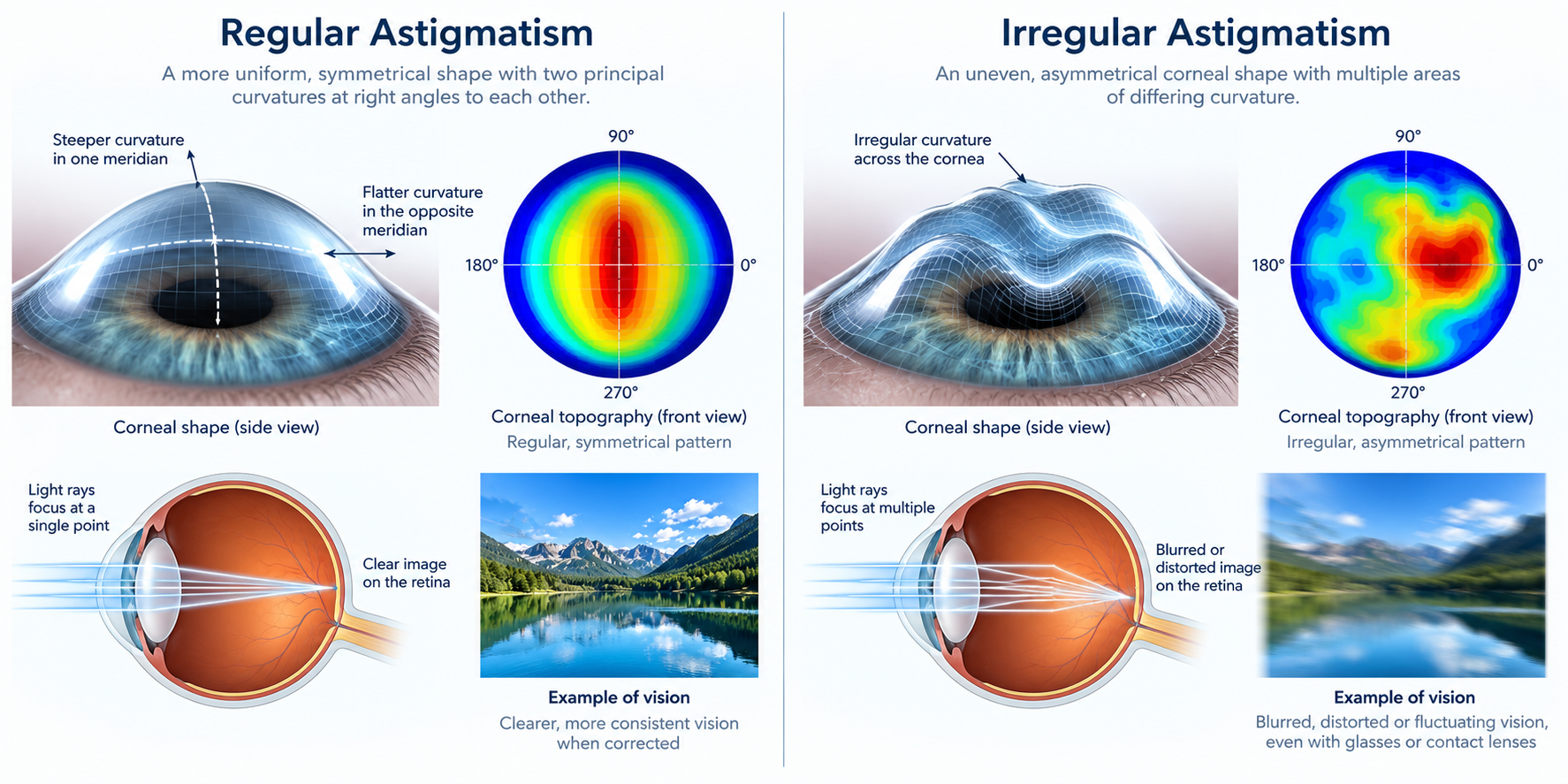
Yes, and the distinction is clinically important. Regular astigmatism occurs when the eye has two principal meridians with different focusing powers that are approximately perpendicular to one another. This is the form commonly corrected using glasses, toric contact lenses and suitable refractive surgery procedures. Irregular astigmatism is more complex because the focusing power may vary unevenly across the cornea, making correction less straightforward.
Irregular astigmatism can be associated with conditions such as keratoconus, corneal scarring or previous eye surgery. In these situations, the priority is to understand the underlying cause rather than simply attempt to remove the prescription. Some patients may require specialist corneal management, and conventional LASIK or SMILE may not be suitable. Research into epithelial thickness mapping and customised corneal treatments has helped improve the understanding of these complex cases, but treatment must always be tailored to the individual eye.
What If You Have Both Astigmatism and Short-Sightedness?
Having both conditions is extremely common. Short-sightedness, or myopia, means distant objects appear blurred because light focuses in front of the retina when the eye is relaxed. Astigmatism adds a difference in focusing power between meridians, which can introduce further blur or distortion. Together, these refractive errors are often described as myopic astigmatism, and suitable laser procedures can correct both components within the same treatment.
The amount of myopia and astigmatism influences how much corneal reshaping is required, so the complete prescription must be considered during surgical planning. Someone with a relatively low prescription may have several potential treatment options, while a person with higher myopia and astigmatism may require a more detailed discussion of corneal thickness, optical quality and alternative procedures. Our article on the prescriptions laser eye surgery can correct provides further information about the range of refractive errors considered during treatment assessment.
Can Astigmatism Return After Laser Eye Surgery?
Laser eye surgery permanently changes the shape of the cornea, but that does not mean every patient’s prescription will remain identical throughout their lifetime. Some patients experience a degree of refractive regression, where part of the original prescription gradually returns. Changes in the natural lens, the ocular surface or other aspects of eye health can also influence vision over time. These possibilities are among the reasons why surgeons assess prescription stability before treatment and continue to monitor patients afterwards.
It is important to distinguish genuine refractive regression from temporary fluctuations caused by dry eyes or normal healing. Blurred vision after surgery does not necessarily mean astigmatism has returned, and the cause should be established through examination rather than assumed. Where a residual or recurrent prescription is identified, further treatment may sometimes be considered, depending on corneal health and the original procedure. London Vision Clinic discusses this subject in its article on whether vision can return to its original prescription after laser eye surgery.
How Accurate Is Laser Eye Surgery for Astigmatism?
Modern laser eye surgery can provide accurate correction of regular astigmatism in appropriately selected patients, but outcomes depend on several interacting factors. These include the strength and axis of the original prescription, the accuracy of the measurements, treatment alignment, corneal characteristics and the healing response. A successful result is not simply a matter of reducing the cylinder value. Researchers also examine how closely the achieved correction matches the intended change in both magnitude and orientation.
This is where scientific research becomes especially valuable. Studies comparing different astigmatism planning methods have investigated whether accounting for additional optical measurements can improve the accuracy of correction. For example, a 2020 study involving Professor Reinstein and Timothy Archer compared vector planning with manifest refraction planning in SMILE for myopic astigmatism. Research of this kind contributes to the continuing refinement of surgical planning, although findings from individual studies should not be interpreted as guarantees of better results for every patient.
The Research Behind More Precise Astigmatism Correction
London Vision Clinic’s scientific publications include several important contributions to the understanding of astigmatism, surgical planning and refractive outcomes.
2014 – Standardising Astigmatism Outcomes
Research establishing consistent methods for reporting the accuracy of astigmatism correction following refractive surgery.
2015 – Understanding Ocular Residual Astigmatism
A study examining the predictability of LASIK cylinder correction in eyes with different amounts of ocular residual astigmatism.
2020 – Comparing SMILE Treatment Planning Methods
Research comparing vector planning and manifest refraction planning for myopic astigmatism correction.
2022 – SMILE for High Myopia and Astigmatism
An investigation of refractive and visual outcomes following SMILE in patients with more complex prescriptions.
Further reading: Explore these studies and other peer-reviewed publications in the London Vision Clinic research library.
Why Personalised Treatment Planning Matters
Two patients may arrive at a consultation with the same amount of astigmatism, yet their eyes may require different approaches. One may have a relatively regular corneal shape and a stable prescription, while another has additional optical characteristics that require more detailed investigation. Corneal thickness, ocular surface health, pupil measurements and the relationship between corneal and internal astigmatism can all influence the treatment recommendation. This is why refractive surgery should be approached as an individual clinical decision rather than a standard procedure applied to every prescription.
At London Vision Clinic, the relationship between research and clinical practice has helped shape the understanding of modern laser vision correction. Work involving Professor Dan Reinstein, Timothy Archer and their colleagues has contributed to the wider scientific literature on astigmatism analysis, surgical outcomes and advanced corneal assessment. For patients, this research provides a valuable reminder that accurate vision correction depends on much more than the laser itself. It begins with understanding the eye, recognising its individual characteristics and determining whether treatment can be performed safely.
Frequently Asked Questions About Laser Eye Surgery for Astigmatism
Patients considering laser eye surgery often have questions about the type of astigmatism they have, the accuracy of treatment and whether their prescription can be corrected. The following answers address some of the most common concerns.
Can laser eye surgery completely correct astigmatism?
Laser eye surgery can correct many forms of regular astigmatism, and some patients achieve little or no residual cylindrical prescription after treatment. However, complete correction cannot be guaranteed. Results depend on the original prescription, corneal characteristics, treatment accuracy and individual healing response. A comprehensive examination is necessary to establish what outcome may be realistic.
Is LASIK or SMILE better for astigmatism?
Both LASIK and SMILE can correct suitable forms of astigmatism, but neither is automatically the better option for every patient. The decision depends on prescription strength, corneal measurements, ocular surface health and other clinical considerations. Your surgeon can explain the expected benefits, limitations and recovery characteristics of each procedure following a detailed assessment.
Can laser eye surgery correct high astigmatism?
Some patients with higher amounts of regular astigmatism may be suitable for laser eye surgery, depending on their overall prescription and corneal characteristics. Higher corrections require careful assessment of treatment accuracy, tissue requirements and the eye’s structural health. Alternative procedures may be considered where corneal laser treatment is unsuitable.
Can astigmatism come back after laser eye surgery?
A degree of astigmatism can sometimes remain or recur after treatment because of healing-related changes, refractive regression or other changes within the eye. However, blurred vision does not always mean the original astigmatism has returned. An eye examination can help identify the cause and determine whether further management is appropriate.
Research-Informed Article – 2026
This article references peer-reviewed research involving Professor Dan Reinstein, Timothy Archer and colleagues, including published studies on astigmatism correction, SMILE, surgical planning and refractive outcomes. Information is provided for educational purposes, and individual treatment suitability must be established through a comprehensive clinical assessment.