
FREE Consultation
LASIK The Gold Standard of Laser Eye Surgery in London
LASIK is one of the most established laser eye surgery procedures in the world and continues to be a highly effective option for modern vision correction. While newer techniques such as SMILE have expanded the range of treatments available, LASIK remains an excellent choice for suitable patients seeking exceptional visual outcomes, a well-understood treatment pathway and a swift return to everyday activities.
Having transformed the lives of millions worldwide, LASIK combines decades of clinical experience with advanced laser technology. Its ability to deliver reliable, high-quality vision correction continues to make it a cornerstone of refractive surgery.
Why Patients Trust London Vision Clinic For LASIK Vision Correction
At London Vision Clinic, treatment is guided by decades of research, innovation and clinical experience rather than a one-size-fits-all approach. The clinic has been at the forefront of laser vision correction for more than 30 years and has played an important role in advancing the techniques and technologies used by refractive surgeons worldwide.
London Vision Clinic is recognised internationally for its research-led approach to LASIK and refractive surgery. Its surgeons have published influential scientific studies, developed patented treatment methods, helped refine modern laser procedures and trained eye surgeons from around the world through specialist education programmes.
| What's Included? Click each link for more information. |
London Vision Clinic
£2,950+
|
Mid-Market Clinics
From £1,200
|
Budget Providers
From £600
|
|---|---|---|---|
| Laser Eye Surgery Procedure | ✓ | ✓ | ✓ |
| Advanced Diagnostic Assessment | ✓ | Limited | ✕ |
| Personalised Treatment Planning | ✓ | Limited | ✕ |
| Research-Led Clinical Protocols | ✓ | ✕ | ✕ |
| Global Training & Education Leaders | ✓ | ✕ | ✕ |
| Published Scientific Outcomes | ✓ | Rarely | ✕ |
What You Say About London Vision Clinic
Beyond Glasses And Contact Lenses
For many people considering LASIK, everyday vision challenges are often linked to long-standing distance blur or visual strain rather than sudden changes. You may notice increasing reliance on glasses or contact lenses for driving, watching screens, or everyday activities, and begin to feel limited by the constant need for visual aids.
These difficulties are usually caused by refractive errors such as short-sightedness or astigmatism, which prevent light from focusing accurately on the retina. Even when well corrected with glasses or contact lenses, many people find that visual freedom, convenience and comfort remain a priority in their daily lives.
While spectacles and contact lenses can manage these conditions, an increasing number of patients now choose LASIK as a long-term solution to reduce their dependence on visual aids and enjoy clearer, more natural vision as part of an active lifestyle.
What is LASIK?
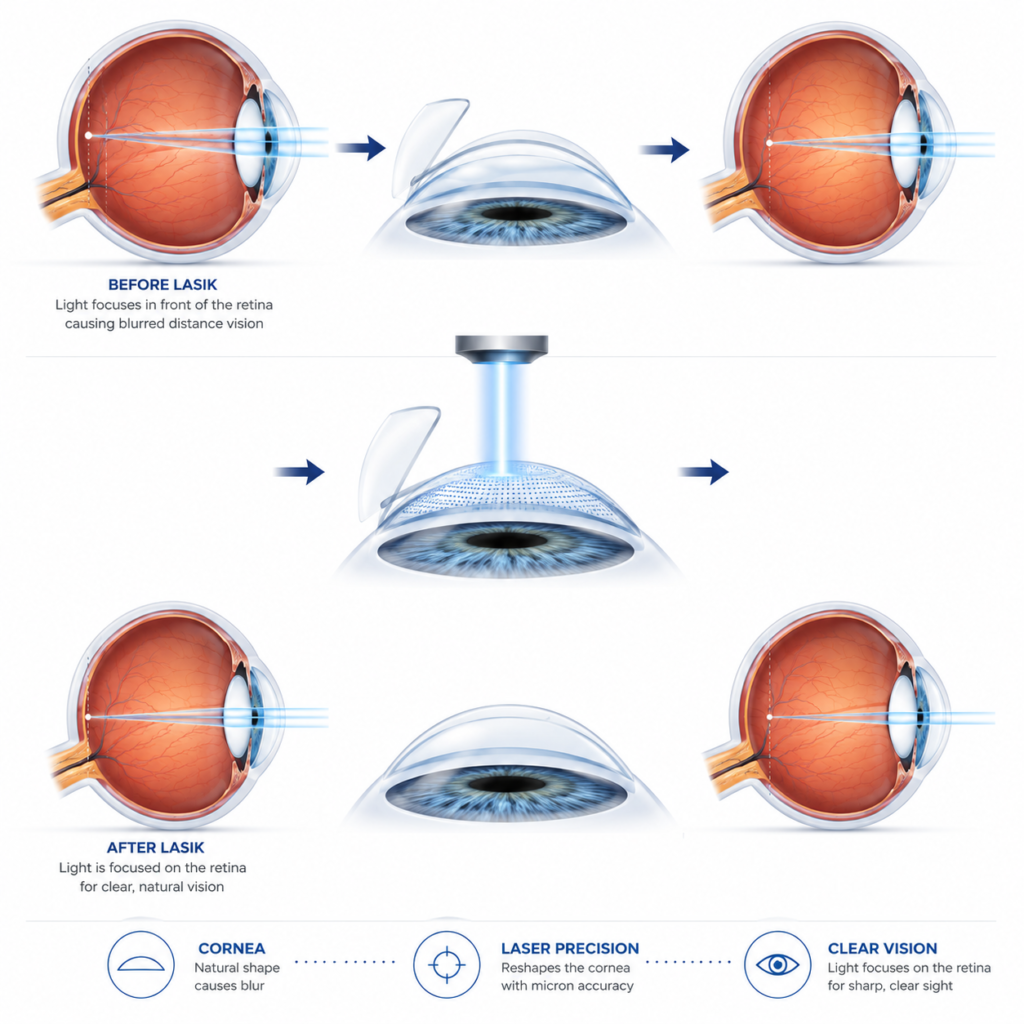
LASIK is a well-established laser vision correction procedure used to treat short-sightedness and astigmatism, with treatment carefully tailored to the individual structure and optical profile of each patient’s eyes. The procedure reshapes the cornea beneath a precisely created flap, allowing the laser to correct vision while preserving the natural surface of the eye.
For many patients, LASIK offers reliable visual outcomes and remains highly suitable for a wide range of prescriptions and lifestyles. By selecting LASIK when a flap-based approach is clinically appropriate, surgeons can deliver excellent visual quality, rapid visual recovery and long-term stability.
Our diagram illustrates how LASIK reshapes the cornea to improve the way light focuses inside the eye. On the left, light rays focus incorrectly due to the shape of the cornea, causing blurred vision. In the centre, a highly precise excimer laser gently reshapes the corneal tissue beneath a thin flap, refining the eye’s focusing power. On the right, the corrected corneal shape allows light to focus accurately on the retina, helping many patients achieve clearer vision with reduced dependence on glasses or contact lenses.
The Pros of LASIK
Recovery Time: While more significant than the keyhole incision created in SMILE, the corneal flap causes much less disruption to the surface of the eye when compared to surface ablation. This allows for much faster recovery times than those seen with PRK or LASEK.
It Can Treat Wavefront Errors: Wavefront errors are higher-order aberrations that can affect our quality of vision, outside of your refractive error. These errors account for around 5% of our overall vision quality. While glasses and contact lenses can treat refractive errors like long- and short-sightedness, they cannot correct wavefront irregularities. Wavefront-guided LASIK (which is offered, as standard, at London Vision Clinic) can correct many of these errors.
The Cons of LASIK
Treatment Options: As we mentioned earlier, there are many variations on LASIK treatment which have swamped the marketplace, causing confusion for prospective patients. As a result, patients may be uncertain of the treatment they are getting, and whether it is the best option for them. It is therefore important to opt for a reliable clinic with clear and transparent fees, and always prepare some important questions to ask at your consultation.
Safety and Comfort: LASIK is less invasive than its surface ablation predecessors. Nonetheless, it may still be associated with some discomfort during and following treatment. The good news is that this discomfort is usually effectively managed with the help of lubricating eye drops and over-the-counter painkillers.
Minor Side Effects: Laser Eye Surgery, in general, can be associated with a few side effects, including dry eyes and night vision disturbances. Typically, these side effects are mild and easily managed with the aftercare provided by your clinic. However, post-LASIK dry eye symptoms typically last for around 3-6 months.
LASIK Offers Rapid Healing Time!
“Aside from the “keyhole” SMILE procedure, there are essentially two groups of Laser Eye Surgery treatments. LASIK involves creating a flap in the cornea, and there are surface treatments, which we know are PRK, LASIK, Epi-LASIK etc. The main difference between the groups is the healing time. The results themselves are pretty much the same three months down the line, but it is how you travel, how your journey is in the interim that makes a big difference, and LASIK offers a rapid healing time.”
Dr Glenn Carp
LASIK has remained the most popular form of laser treatment.
LASIK (Laser-assisted in situ keratomileusis) was approved for use in refractive surgery in the late 1990s, representing a huge development in the Laser Eye Surgery field. Since then, LASIK has remained the most popular form of the treatment, and as such, one of the most popular elective procedures in the world.
The corneal flap that characterises LASIK helped to significantly reduce recovery times compared with surface procedures (PRK/LASEK). As a result, the vast majority of patients can return to many of their usual activities; including returning to work, within a couple of days of their treatment. In the video below, you can see a LASIK procedure performed in real time!
FAQs
Can I have my LASIK assessment and treatment in one visit if I’m travelling into London?
Yes, in many cases this can be arranged at London Vision Clinic, depending on your clinical findings and availability.
For patients travelling into central London from outside the capital or fitting treatment around work commitments, the clinic can often coordinate advanced diagnostics, surgeon consultation and treatment planning into a streamlined visit. Your suitability is always confirmed first through full clinical assessment to ensure safety is not compromised for convenience.
Is LASIK suitable if I work long hours on screens or in a visually demanding London-based role?
Yes. Many patients who work in screen-intensive roles such as finance, technology, media and professional services choose LASIK because of its rapid visual recovery and predictable visual performance.
During your assessment, your surgeon will consider digital eye strain, focusing behaviour and visual demands at work to help determine whether LASIK is the most appropriate option for your lifestyle and working environment.
How do London traffic, commuting and city lifestyles affect recovery after LASIK?
Most patients can return to light daily activities very quickly after LASIK, including public transport commuting. However, your clinical team will advise you specifically about safe timing for driving, screen use and busy environments during the first few days.
In a city setting such as London, factors like air quality, dry environments and prolonged screen exposure are also considered as part of your aftercare guidance to support comfort and stable healing.
Does choosing a specialist clinic in London make a difference to LASIK planning?
Yes. Specialist clinics with advanced diagnostic equipment can measure far more than a standard prescription alone.
At your LASIK consultation, high-resolution corneal imaging and optical profiling are used to assess corneal structure, stability and individual visual characteristics. This level of analysis allows your surgeon to decide not only whether LASIK is suitable, but also whether an alternative procedure would offer a safer or more predictable outcome for your eyes.