
FREE Consultation
Treating Hyperopia, Farsightedness - London
Over the last few decades, laser eye surgery has evolved into one of the most precise and clinically advanced elective procedures in modern medicine. Continuous innovation in diagnostics, laser technology and surgical techniques now allows millions of people worldwide to experience clearer, more natural vision.
Despite this progress, many people still do not realise that laser eye surgery may be a suitable and highly effective option for them. Today, treatment can safely correct a wide range of refractive errors, including very high prescriptions.
At London Vision Clinic, our surgeons routinely treat complex and advanced cases of refractive error, including hyperopia, astigmatism, presbyopia and myopia.
What is Hyperopia?
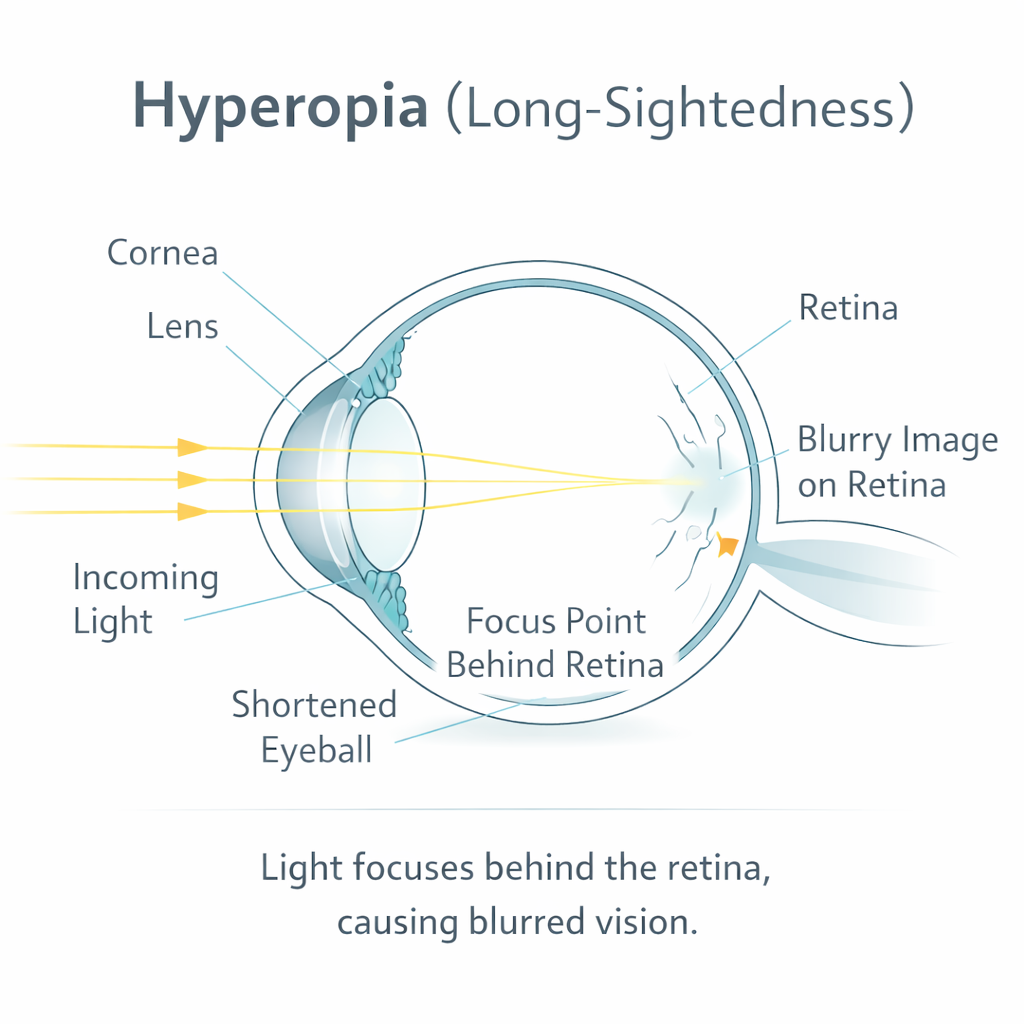
Hyperopia, more commonly known as long-sightedness, is a refractive error in which distant objects may appear clearer than near objects, while close work often feels strained or blurred.
Long-sightedness occurs when the shape of the eye causes light to focus behind the retina rather than directly on it. In people with hyperopia, the eye is often slightly shorter than average or the cornea is flatter than normal. As a result, incoming light does not converge at the correct point on the retina.
To compensate for this, the eye must work harder to focus, particularly at near and intermediate distances. Over time, this extra effort can lead to symptoms such as eye strain, headaches, visual fatigue and difficulty with reading or prolonged screen use.
In younger patients, the eye’s natural focusing system can often mask hyperopia for many years. However, as focusing ability reduces with age, symptoms usually become more noticeable.
In the video below, one of our consultant surgeons explains what hyperopia is and how it affects vision.
Different Types Of Hyperopia
There are several recognised forms of hyperopia, although the most commonly encountered are physiological hyperopia, pathological hyperopia and acquired hyperopia.
Physiological hyperopia is the most common form. It occurs when there is a natural mismatch between the length of the eye and the overall focusing power of the cornea and the lens. Many people are born mildly long-sighted, and in childhood the eyes are often able to compensate. Symptoms may appear later in life as the eye’s focusing reserve gradually reduces.
Pathological hyperopia is less common and is usually associated with structural abnormalities of the eye. In these cases, the eye is significantly shorter than normal or has underlying anatomical differences. Vision correction can still be very effective, but treatment planning must take the individual eye structure into careful consideration.
Acquired hyperopia develops later in life and may be associated with changes within the eye or certain medical conditions. In some cases, it can also be linked to lens changes as part of the natural ageing process.
Treating Hyperopia
The underlying principle of laser eye surgery is to reshape the cornea so that light is focused accurately onto the retina.
In long-sighted patients, the cornea is carefully reshaped to increase its focusing power. This allows light to converge sooner, so that it reaches the retina instead of focusing behind it.
Several laser techniques can be used to treat hyperopia, including LASEK/PRK, LASIK and SMILE Pro (in carefully selected cases).
Although each procedure accesses the cornea in a different way, the same optical goal applies. A high-precision laser is used to reshape the corneal surface in a carefully planned pattern in order to restore more accurate focusing.
Laser eye surgery can significantly improve both distance and near vision in suitable hyperopic patients. However, some patients, particularly from their forties onwards, may also be affected by age-related near-vision changes. In these cases, treatment planning may include PRESBYOND® Laser Blended Vision to address both long-sightedness.
Alternative Treatment Options for Hyperopia
Since its introduction more than forty years ago, laser eye surgery has developed into a safe, reliable and well-established treatment for many people. However, not every patient with hyperopia will be suitable for corneal laser correction.
Factors such as corneal thickness, overall eye health, dry eye disease and the presence of other ocular or medical conditions must be carefully assessed before treatment is recommended.
Traditionally, hyperopia is managed using glasses and contact lenses. While this remains effective for many patients, some people; particularly those with higher prescriptions or additional age-related changes, may benefit from surgical alternatives.
For higher degrees of long-sightedness, or where lens-based correction is more appropriate, intraocular lens procedures are often recommended.
Intraocular lenses are artificial lenses that are implanted inside the eye, positioned behind the pupil. Depending on the individual treatment plan and the type of lens used, these procedures may be described as implantable lenses, phakic intraocular lenses, clear lens extraction or lens exchange surgery. Some patients may also encounter terms such as intra-corneal lens implants, Artisan® lenses, Prelex® lenses or refractive lens replacement.
These advanced treatment options allow patients with higher or more complex long-sighted prescriptions to achieve high-quality vision correction when laser treatment alone is not the most suitable solution.