
How The Eye Works
Often easy to overlook, the basics are always a great place to start. So, we’ve put together short and digestible explanations about the eye, types of prescription, and how to interpret them.
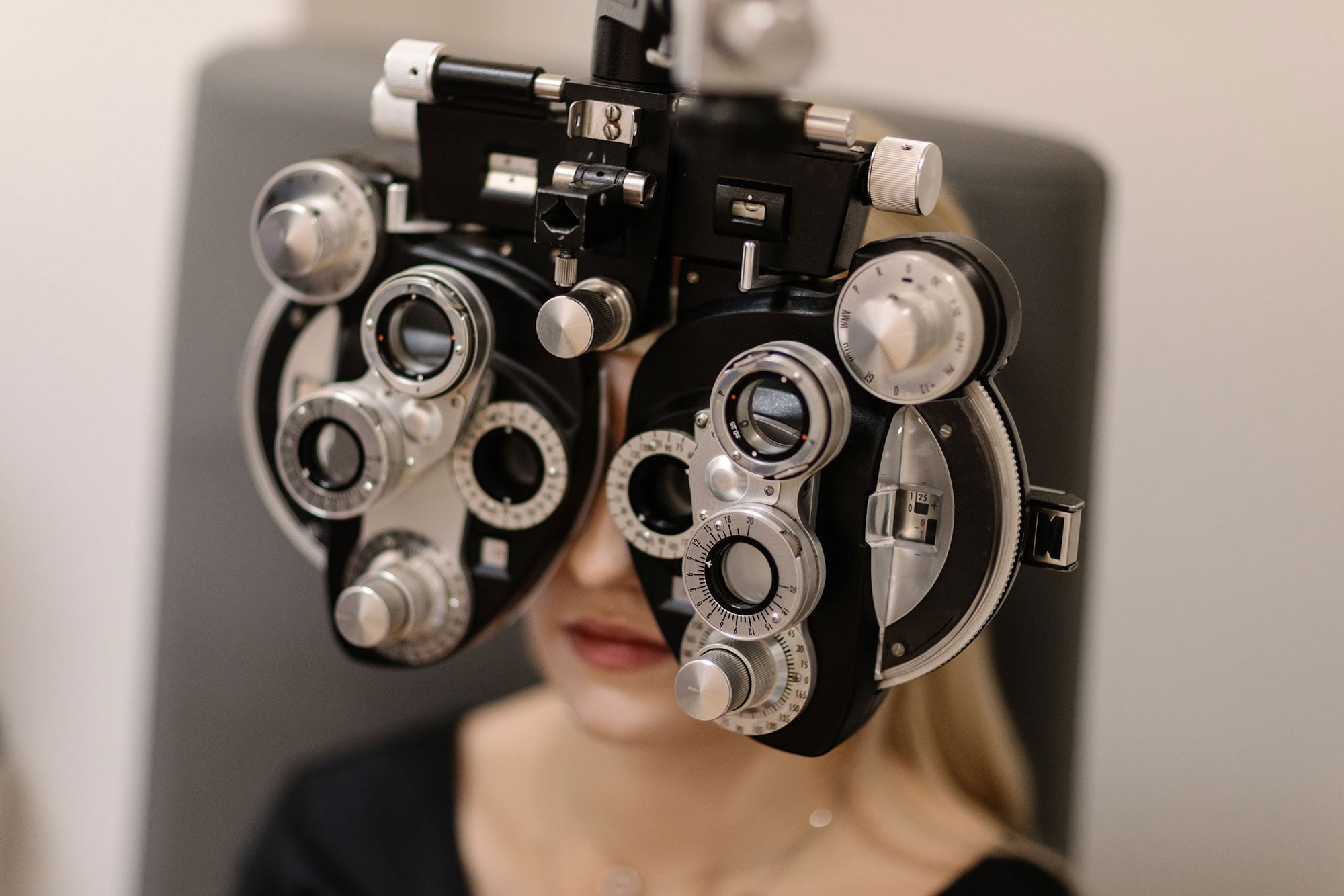
Your Eye is like a Camera
The human eye is an incredibly complex organ with millions of working parts. But when looked at in a more simple way, it can be compared to a camera. For example, like a camera, your eye has:
- A variable opening, the pupil;
- A lens system – this includes a transparent layer called the cornea (responsible for focusing) and a spherical lens that sits behind the iris inside the eye;
- A ‘film’-like layer called the retina – a layer of photosensitive cells at the back of the eye.
There are also various sets of muscles that control the dilation of the pupil and the shape of the lens system, effectively controlling the focus and ‘zoom’ functions of the eye.
When light bounces off of objects around us, it enters the eye through the pupil and the lens system.
The cornea and lens work together to refract this light, focusing it on the retina at the back of the eye. The photosensitive cells that make up the retina (known as cones and rods) translate the light photons into electrical signals which are then sent to the brain via the optic nerve.
The brain can then process these signals into a picture of the world around us, just as a Polaroid camera ejects a photograph (only clearer!).
For the brain to process this image effectively, four things are required:
- The image must be reduced to fit onto the retina;
- The scattered light must be focused accurately at the surface of the retina;
- The image must be curved to match the curve of the retina;
- The brain must be able to interpret the image.
Muscles attached to the lens contract and relax, changing the shape of the lens system. This keeps light focused on the retina, even when your eyeballs move. This complex set of muscles is controlled by the nervous system.
Most refractive errors occur when the eye is unable to focus light onto the retina effectively. This is most commonly due to the shape of the cornea, the length of the eye, or the elasticity of the lens.
The most common refractive errors are (myopia), long-sightedness (hyperopia), astigmatism, and presbyopia. These errors can usually be corrected with external visual aids such as glasses and contact lenses, or by changing the shape of the cornea with Laser Eye Surgery.
Myopia (Short-Sightedness)
Myopia! Also known as short-sightedness, occurs when the eyeball is too long or the cornea is too steep.
This means that when light enters the eye, it is focused slightly in front of the retina, rather than directly on it. As a result, distant objects appear blurry.
Myopia affects the ability to focus on objects in the distance, while their near vision may still be very good. For example, people with myopia may struggle to read the numbers on buses or read road signs, while reading a book is easy. This is because the eye is naturally focused at a near distance.
Myopia is the most common refractive error, affecting around 2.6 billion people worldwide. The first Laser Eye Surgery procedure was designed to correct myopia. The treatment involves changing the shape of the cornea to correct the way it directs light into the eye. As a result, light is focused onto the retina, enabling the brain to better process distant objects.
Hyperopia (Long-sightedness)
Hyperopia, known more commonly as long or far-sightedness, occurs when the eyeball is too short or the cornea is too flat.
In contrast to myopia (short-sightedness), hyperopic eyes focus light beyond the retina. This causes near vision to become blurred while distance vision is unaffected.
Younger people with this refractive error can often make up for this abnormality as their eyes are able to ‘self-focus’. By utilising their ‘zoom’ function which is intended for close-up tasks such as reading, the eyes can compensate for the blurriness. However, the ‘zooming ability of the eye gradually weakens as we age. As a result, many people with hyperopia find that their vision gets worse as they get older.
Individuals with hyperopia may also find that they need reading glasses earlier – often before they reach 40. This means that they may require glasses or contact lenses that accommodate both near and distance vision (bifocals).
In many cases, Laser Eye Surgery can be effective at treating hyperopia. This involves changing the shape of the cornea to adjust the way light is directed at the retina. Laser Eye Surgery can also correct ageing eyes (presbyopia).
Presbyopia (Ageing Eyes)
As we get older, our vision begins to deteriorate. Presbyopia is a natural part of the eye’s ageing process.
Many people are lucky enough to spend most of their lives without the restrictions of glasses and contact lenses. But while they may not have to worry about the effects of myopia, hyperopia, or astigmatism, almost everyone will eventually succumb to another refractive error – presbyopia (ageing eyes).
Most people will begin to notice the effects of presbyopia between the ages of 40 and 50.
As we get older, our eyes – like many other parts of our bodies, begin to deteriorate. The lens gradually becomes less flexible, which affects its ability to change shape and shift the eye’s focus from near to distance. Effectively, this means that the eye’s ‘zoom’ system becomes weaker.
This makes it increasingly difficult to read small print in books, menus, and receipts and to focus on other close-up tasks. Individuals with a pre-existing refractive error may also find that they require multiple visual aids for different distances, or that they require bifocal or varifocal lenses.
Reading glasses are the most common method for correcting presbyopia. In some cases, Clear Lens Exchange procedures (replacing the lens inside the eye with an artificial one) can also help. But Laser Eye Surgery can also help.
At London Vision, we have been correcting presbyopia since 2004 with PRESBYOND® Laser Blended Vision. This innovative procedure is less invasive and more safe than Clear LEns Exchange as the lens does not need to be removed.
Astigmatism
Astigmatism occurs when the eyeball or cornea is abnormally shaped, like a rugby ball as opposed to a football.
This abnormal curvature means that the cornea has different measurements horizontally and vertically. As a result, light entering the eye is focused at two separate planes, rather than at a single point on the retina.
These multiple planes of focus can cause the images being sent to the brain to appear blurry or distorted. Some individuals with astigmatism may also experience “ghosting” – a kind of double vision.
Around half of people with myopia or hyperopia also have some degree of astigmatism.
Laser Eye Surgery can be effective at correcting astigmatism, whether it occurs alone or alongside myopia or hyperopia.
Understanding Visual Acuity
Whether you use glasses or contact lenses or are even considering Laser Eye Surgery, you will likely have heard the term ‘visual acuity’ a lot. This term essentially refers to the standard of your vision quality! That is, how well you see.
Your visual acuity is assessed by testing your central vision. For example, your ability to distinguish the details of objects at different distances. This is most commonly done using the Snellen Chart.
The Snellen Chart features rows of letters in variable sizes, getting progressively smaller on each line. To test your visual acuity, your optometrist will place the chart 20 feet (or 6 metres) away. You will then be asked to read the letters aloud until they become too small for you to clearly discern.
What does 20/20 mean?
Each line on the Snellen Chart has a label. One of the lower lines on the chart is the ’20/20′ line – a term many people are familiar with. Individuals who can distinguish the characters on this line are considered to have ‘normal’ visual acuity – they can see at 20 metres what a person with normal vision would be expected to see at that distance.
A person with 20/20 vision would be able to read the letters on the 20/40 line (three lines above) at a distance of 40 feet, and so on. If they cannot read the letters beyond this line, they have 20/40 vision.
But it is possible to have better than ‘normal vision’.
There are several lines beyond the 20/20 line on the Snellen Chart. Some people may be able to read the letters on the 20/16 line, meaning they can read at 20 feet what a person with normal visual acuity could only read at 16 feet away.
Visual acuity tests like the Snellen Chart also measure a person’s ‘best-corrected’ vision. While many people with myopia may struggle to read the letters on even the first or second line of the chart without glasses, they can often reach the 20/20 line with the help of their visual aids.
In most cases when visual acuity is mentioned, this refers to best-corrected visual acuity. For example, in the UK, drivers are required to have 20/40 visual acuity in order to legally drive. This means that you can drive if you have a best-corrected visual acuity of 20/40 or better – with glasses or contact lenses.
In most cases, Laser Eye Surgery aims to achieve the same visual acuity as your best-corrected level achieved with glasses and/or contact lenses. Many patients are even able to achieve better results!
Understanding Your Prescription
What do all the numbers and symbols mean?
Your prescription measures the extent of your refractive error, be it myopia (short-sightedness), hyperopia (long-sightedness), astigmatism, and presbyopia. This is measured in units called dioptres.
More specifically, these measurements refer to the amount of refractive correction you require to achieve ‘normal’ visual acuity. For example, one dioptre is the equivalent of a lens that can effectively focus your vision on an object one metre away. The more severe your refractive error, the higher the numbers on your prescription.
A typical prescription features three numbers; for example: -5.00 / -1.50 x 180.
- The first number (-5.00) identifies the degree of short-sightedness – indicated by a minus (-)symbol or long-sightedness, indicated by a plus symbol (+).
- The second number (-1.50) identifies the extent of astigmatism: This may be preceded by a plus or minus symbol (usually a minus in the UK).
- The third number (180) indicates the axis, in degrees, of your astigmatism.
The ‘180’ in this example indicates that the astigmatism is horizontal. When this is all put together, the example prescription tells us that the patient is moderately short-sighted with a moderate degree of astigmatism in a horizontal direction.